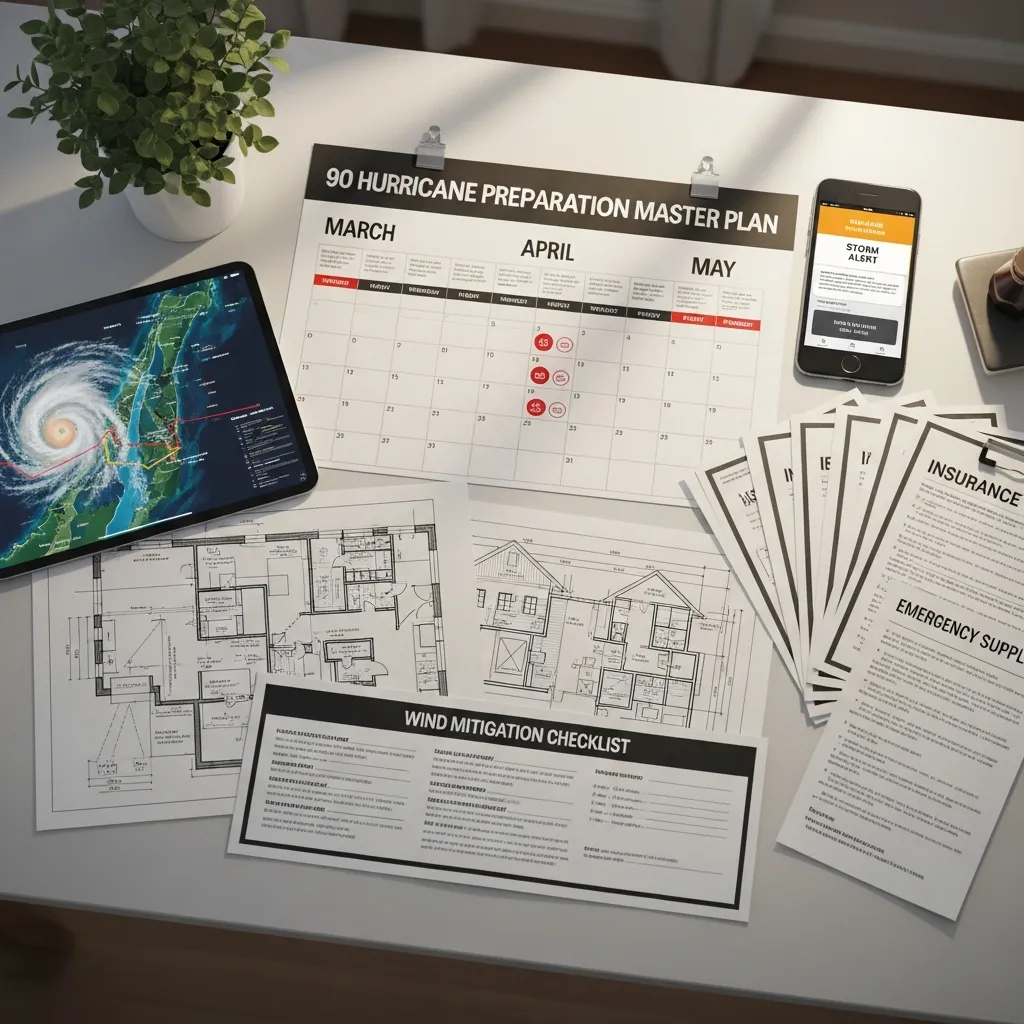
The 90-Day Hurricane Preparation Plan: Week-by-Week Guide from March Through May
The 90-Day Hurricane Preparation Plan: A Week-by-Week Guide from March Through May
The Problem with Every Hurricane Checklist You’ve Ever Seen
Search “hurricane preparation checklist” and you will find dozens of lists from FEMA,
the Red Cross, state emergency management offices, and insurance companies. They are
all well-intentioned. They are all incomplete in the same way.
These lists are flat. They present thirty or forty action items with no sequencing, no
priority structure, and no acknowledgment that some items take months of lead time
while others take an afternoon. “Secure your windows” appears alongside “buy
batteries.” “Review your insurance” sits next to “stock water.” The result is that the
easiest items get done first — batteries, water, canned food — and the hardest, most
important items get deferred until they cannot be completed before June. The
homeowner feels productive because items are being checked off. But the items being
checked off are the ones that matter least.
This is not a failure of motivation. It is a failure of structure. Behavioral psychologist
Peter Gollwitzer’s research on implementation intentions has shown that people are
dramatically more likely to complete a task when they have a specific plan that answers
three questions: what will I do, when will I do it, and what is the first step? A flat
checklist answers the first question and ignores the other two.
The plan below is built differently. It is sequenced around calendar reality and lead
times. Structural decisions come first because they require the longest lead times —
weeks for consultations, weeks for manufacturing, weeks for installation. Supply
acquisition comes last because it requires the shortest lead time and the least decision
complexity. This is the opposite of how most homeowners naturally approach
preparation, and it is the sequence that actually works.
When Should I Start Preparing for Hurricane Season?
March. Hurricane season officially begins June 1, but the most important preparation
steps — structural protection decisions, insurance review, contractor scheduling, and
installation — require 8 to 12 weeks of lead time. Contractor availability tightens sharply
in April and May as demand increases, and many manufacturers require 4 to 6 weeks
for custom fabrication. Starting in March gives homeowners enough time to assess
vulnerabilities, make informed decisions about permanent protection, schedule
installations, and complete supply acquisition before the season begins. Homeowners
who wait until May are competing for limited contractor capacity at premium pricing
with fewer product options available.
Phase 1: ASSESS — March
Weeks 1 through 4. Understand what you have, what you’re missing, and what matters most.
Week 1: Property Vulnerability Walkthrough
Walk the exterior of your home with a notebook or your phone camera. Count every
opening: windows, doors, sliding glass doors, skylights, garage doors. Note which
openings have existing protection (shutters, impact glass, screens) and which are
unprotected. Measure the largest openings — these are the most vulnerable points in
your building envelope and the first to fail during a hurricane. Photograph anything you
are unsure about. This walkthrough takes one to two hours and produces the single
most important document in your preparation: a complete inventory of your home’s
exposure.
Week 2: Insurance Policy Review
Pull your actual policy — not the summary, the declarations page. Find your hurricane
deductible and calculate the dollar amount. If it is listed as a percentage, multiply it by
your dwelling coverage limit. Check whether you have a separate flood insurance policy.
Review your contents coverage limits and verify they reflect current replacement costs,
not purchase prices. If you do not have a wind mitigation inspection on file (Form OIR-
B1-1802 in Florida), note that — you will need one to qualify for premium discounts
once protection is installed. This review may be the most financially consequential hour
you spend this year.
Week 3: Roof and Structure Assessment
Schedule a professional roof inspection if your roof is more than ten years old. Ask
about roof-to-wall connections (hurricane straps or clips), secondary water resistance,
and roof deck attachment method — all of which affect both your home’s structural
performance in a hurricane and your eligibility for insurance credits. Check your garage
door: if it is not rated for wind pressure, it is the single largest unprotected opening in
your building envelope. Note any existing structural vulnerabilities — older windows,
single-pane glass, aging seals, deteriorating frames.
Week 4: Research and Shortlist
Using the vulnerability inventory from Week 1, begin researching protection options for
your unprotected openings. The comparison framework from earlier in this series —
shutters, screens, and impact glass evaluated across protection level, deployment
convenience, aesthetics, insurance impact, and total cost of ownership — provides the
decision architecture. Create a shortlist of two to three product categories and identify
two to three contractors for each. Check Florida Product Approval or Miami-Dade NOA
certification numbers for any product you are considering. Schedule consultations for
early April.
What Should I Do First When Preparing for a Hurricane?
Start with a property vulnerability walkthrough. Walk the exterior of your home and
count every opening — windows, doors, sliding glass doors, skylights, and garage doors.
Note which openings have certified hurricane protection and which are unprotected.
Measure the largest openings, as these represent the greatest structural risk. Then
review your insurance policy: find your hurricane deductible (the dollar amount, not the
percentage), confirm whether you have flood coverage, and verify your dwelling limits
reflect current replacement costs. These two steps — property assessment and insurance
review — establish the foundation for every subsequent preparation decision and should
be completed before purchasing any supplies or scheduling any installations.
Phase 2: DECIDE — April
Weeks 5 through 8. Convert research into decisions and decisions into scheduled
commitments.
Week 5: Contractor Consultations
Meet with the contractors you identified in Week 4. For each consultation, bring your
vulnerability inventory and ask the six questions from the comparison guide: What is
the Florida Product Approval or Miami-Dade NOA number? What specific ASTM and
TAS standards was the product tested to? Will the installation qualify for wind
mitigation credits on all openings? What is the total installed cost and what does the
warranty cover? What maintenance is required over the lifespan? Can you see a
completed installation on a similar home? Reputable contractors welcome these
questions. Contractors who deflect them are telling you something worth hearing. Get at
least two written estimates for comparison, and confirm that each estimate specifies the
product model, certification number, and installation timeline.
Week 6: Permanent Protection Assessment
With consultation information in hand, evaluate your options against your personal
priorities. If deployment convenience and remote activation matter most, motorized
hurricane screens and impact glass are your primary candidates. If upfront budget is the
controlling factor, traditional shutters offer the lowest entry point. If aesthetics and
zero-maintenance permanence are priorities, impact glass leads. If you want the
flexibility of daily-use functionality — insect screening, solar shading, privacy —
alongside hurricane protection, motorized screens offer capabilities that single-purpose
products do not. There is no universally correct answer — only the answer that aligns
with your priorities, your budget, and your risk profile. Revisit the five-criteria
framework from earlier in the series and apply your own rankings honestly.
Week 7: Financial Planning
Get the financial picture complete before committing. Calculate the total investment
including installation. Estimate the annual wind mitigation premium savings you will
qualify for once the work is documented on a wind mitigation inspection. Factor in the
hurricane deductible exposure you are reducing — the difference between catastrophic
interior damage from an envelope breach and manageable exterior damage from an
intact envelope. Some homeowners finance hurricane protection through home equity
lines, home improvement loans, or insurance premium savings that offset the monthly
cost over time. The math is different for every home, but the math should be done before
the decision is made.
Week 8: Decision and Scheduling
Make your decision and schedule the installation. This is the week where intention
becomes commitment. The installation timeline matters: custom-manufactured
products like motorized screens and impact windows typically require four to six weeks
for fabrication after measurements are confirmed. If you schedule the order in the first
week of April, installation can be completed in May — before hurricane season begins. If
you wait until May to start this process, you are competing with every other homeowner
who waited, and the installation may not be complete by June 1.
Phase 3: IMPLEMENT — May
Weeks 9 through 12. Execute the tactical preparation that most checklists treat as the
entire plan.
Week 9: Hurricane Supplies
Now — and only now — is the right time to acquire hurricane supplies. Not because
supplies do not matter, but because they require the least lead time and the simplest
decisions. Water: one gallon per person per day for a minimum of seven days. Non-
perishable food for seven days. Medications: 30-day supply of all prescriptions.
Flashlights and batteries. A battery-powered or hand-crank weather radio. First aid kit.
Cash in small bills. Phone chargers and portable power banks. Fuel for vehicles and
generators. This is the part of preparation that most people start with — and the part
that matters least if your building envelope fails.
Week 10: Emergency Communication Plan
Establish a family communication plan that does not depend on a single technology.
Identify an out-of-area contact person who can serve as a central relay if local cell
networks are overwhelmed. Document the plan on paper — not only on your phone.
Know your evacuation zone and at least two evacuation routes. If you have pets, identify
pet-friendly shelters or hotels along your routes. Program your county’s emergency
management number into every family member’s phone. Register for local emergency
alert systems. If elderly or mobility-limited family members live nearby, include their
preparation in your plan.
Week 11: Final Inspections and Testing
If hurricane protection has been installed during April or early May, this is the week to
test every system. Deploy every screen, close every shutter, and inspect every seal. Verify
that motorized systems operate on battery backup. Confirm that remote or app-based
deployment works from outside the home. If you installed impact glass, verify the
window frames are properly sealed and that no installation debris remains in the tracks.
Test your generator if you have one. Replace the batteries in smoke detectors and
weather radios. Walk the exterior one more time and confirm that nothing has changed
since your Week 1 assessment — no new vulnerabilities from landscaping, construction,
or wear.
Week 12: Plan Review and Documentation
Compile your completed preparation into a single document or folder. Include your
insurance declarations page with hurricane deductible calculated in dollars, wind
mitigation inspection form, product certification numbers for every installed protection
system, contractor contact information, warranty documentation, and your family
communication plan. Store digital copies in cloud storage accessible from any device
and any location. Store a physical copy in a waterproof container in a location you can
access after a storm. Share the location of both with your out-of-area contact person.
Review the plan with every member of your household, including children old enough to
understand evacuation procedures. When June 1 arrives, you are not hoping for the
best. You are prepared.
How Do I Prepare My Home for Hurricane Season Step by Step?
Hurricane preparation works best as a three-phase, 90-day process from March through
May. Phase 1 (March) is ASSESS: conduct a property vulnerability walkthrough
counting all openings, review your insurance policy including hurricane deductible and
flood coverage, schedule a roof inspection, and research protection options. Phase 2
(April) is DECIDE: meet with contractors, evaluate protection options against your
priorities using a structured comparison framework, plan financing, and schedule
installation. Phase 3 (May) is IMPLEMENT: acquire hurricane supplies (water, food,
medications, batteries), establish a family communication plan, test all installed
protection systems, and compile documentation into a single accessible folder. The key
differentiator from standard checklists is sequencing: structural protection decisions
come first because they require the longest lead times, while supply acquisition comes
last because it requires the shortest.
What Is the Most Important Hurricane Preparation?
Protecting the building envelope — every window, door, skylight, and garage door in
your home. If the building envelope holds during a hurricane, interior damage is
minimal and insurance claims are straightforward. If the envelope is breached, the
resulting interior water and wind damage can reach tens of thousands of dollars, and the
insurance claim becomes complicated by wind-versus-water attribution disputes.
Structural protection also qualifies homeowners for wind mitigation insurance credits
(10 to 45 percent off windstorm premiums in Florida) that reduce costs every year. By
contrast, supplies like water, food, and batteries — while necessary — can be acquired in
days and do nothing to prevent structural damage. The priority order is structure first,
insurance second, supplies third.
What Separates the Prepared from the Scrambling
The difference between a homeowner who is ready on June 1 and a homeowner who is
scrambling is not motivation. It is not money. It is sequence. The homeowner who
started in March with a vulnerability walkthrough and an insurance review made their
structural decisions in April when contractors were available and manufacturers had
capacity. Their installation was completed in May. Their supplies were gathered in the
final weeks. When the first tropical system appears on the forecast, they press a button,
check their documentation folder, and focus on their family.
The homeowner who started in May with a trip to the hardware store made the
decisions in the wrong order. By the time they realized structural protection was the
priority, contractors were booked through June, lead times had extended past the start
of the season, and the premium pricing of peak demand had arrived.
You now have the plan. As you move through the DECIDE phase in April, you will
encounter products claiming to be “hurricane rated.” That phrase appears on everything
from $500 window film to $50,000 whole-home systems. It has no legal definition. The
next article in this series teaches you how to distinguish genuine certification from
marketing language — the specific test standards, approval numbers, and questions that
separate verified performance from advertising.