The Single Point of Failure That Determines If Your Home Survives a Hurricane
The Single Point of Failure That Determines Whether Your Home Survives a Hurricane
Start with the photograph. You've seen it before — in news coverage, on social media, in
the insurance adjuster's file. A house in southwest Florida, post-Hurricane Ian. The roof
is gone. Not partially damaged. Gone. The interior walls are exposed to the sky like the
cross-section of a dollhouse. Furniture is scattered across what used to be a living room.
Drywall hangs in sheets. The family's belongings are indistinguishable from debris.
Now rewind.
Twelve hours before that photograph was taken, this house was intact. The structure
was sound. The roof was attached. The walls were standing. Everything was where it was
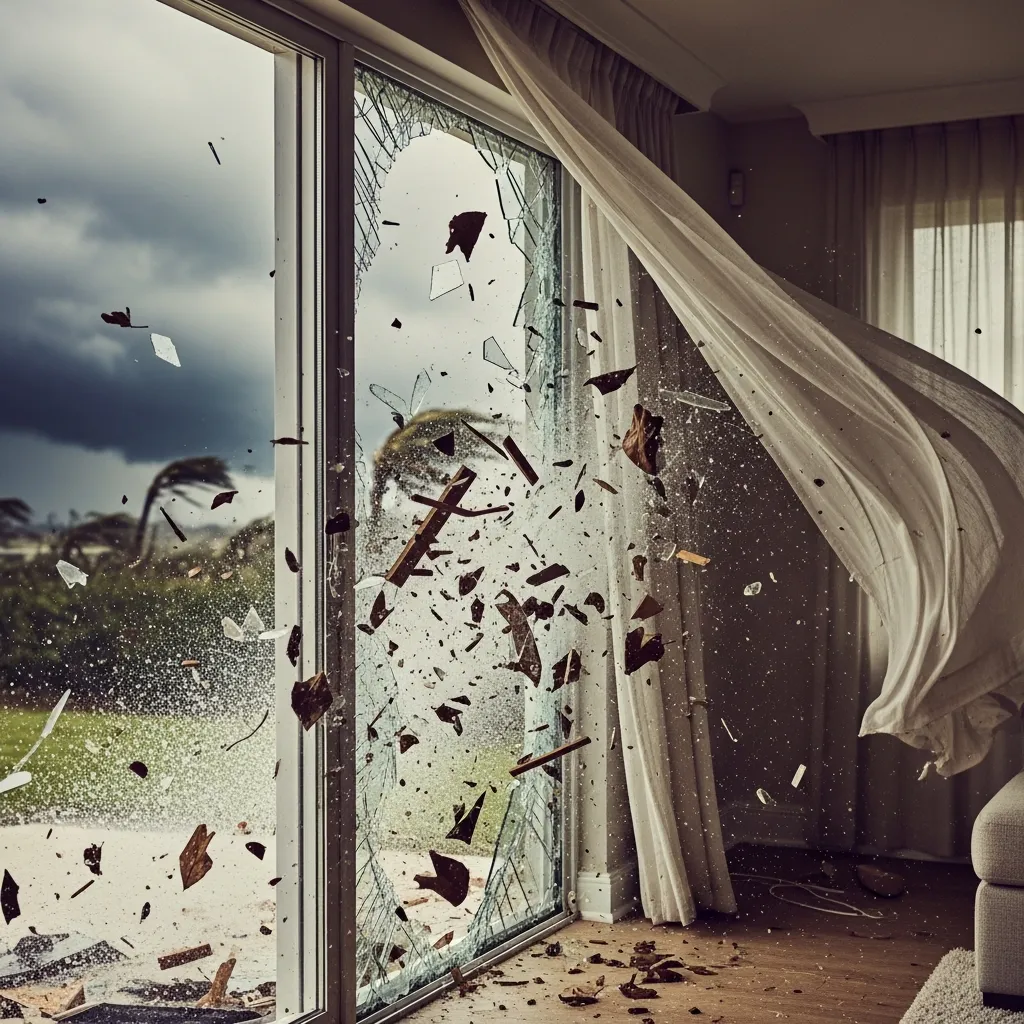
supposed to be. And then a single piece of airborne debris — a section of fence, a piece of
a neighbor's roof tile, a broken tree limb moving at over a hundred miles per hour —
struck a sliding glass door and punched through it.
That was the moment the house began to die.
Not the moment the roof came off. Not the moment the rain flooded the interior. Not
the moment the walls buckled. Those came later, and they came inevitably — but they
were consequences. The cause was a single breached opening. One broken barrier
between the inside of the home and the force of the storm.
Building scientists call this the failure of the building envelope — the continuous
barrier of walls, roof, windows, and doors that separates the controlled interior of a
structure from the uncontrolled exterior environment. When that barrier is intact, a
home can withstand extraordinary forces. When it is breached — even at a single point
— the physics change instantly and catastrophically.
Here is the sequence, documented by the Natural Hazards Center at the University of
Colorado Boulder and confirmed in post-storm forensic investigations after every major
hurricane since Andrew: A windborne projectile strikes an unprotected opening. The
glass or door fails. Wind enters the structure. Internal pressure surges — in some cases
doubling or tripling within seconds. That pressure pushes outward against the roof from
below while the hurricane's aerodynamic forces pull upward from above. The roof-to-
wall connections, designed to resist external loads, are now fighting forces from both
directions simultaneously. They fail. The roof separates. The interior is exposed. Rain,
measured in inches per hour during a hurricane, destroys everything that the wind
didn't.
The entire sequence — from breach to ruin — can take less than sixty seconds.
How Does a Hurricane Actually Damage a House?
Most people assume hurricane damage comes from the wind itself — that raw force
simply tears a building apart. The reality, documented across decades of post-storm
research, is more precise and more preventable. Hurricane damage to residential
structures follows a cascading failure sequence that begins with a breach of the building
envelope. When windborne debris penetrates an unprotected window, door, or garage
opening, wind enters the structure and generates sudden internal pressurization. This
internal pressure, combined with the negative pressure already acting on the roof from
external wind flow, overwhelms roof-to-wall connections and causes roof separation.
Once the roof is compromised, rain and wind destroy the interior. The building does not
fail all at once. It fails in a chain — and the first link is almost always an unprotected
opening.
Why "Built to Code" Does Not Mean "Built to Survive"
If you own a home in Florida built after 2002 — the year the Florida Building Code was
overhauled in the wake of Hurricane Andrew — you may believe your home is
engineered to survive a major hurricane. That belief is understandable. It is also
incomplete.
Building codes establish minimum structural requirements. They specify how a roof
must be attached to walls, how walls must be anchored to foundations, how loads must
transfer through the structural system. These requirements are real, and they represent
significant improvements over pre-Andrew construction standards. Forensic analysis
conducted by Florida International University's International Hurricane Research
Center after Andrew revealed that most building damage was caused by building
envelope failure — specifically, roof covering blow-off, glass breakage from windborne
debris, and collapse of large doors such as garage doors.
The code improvements since Andrew have addressed many of these failures. But here
is what the code does not guarantee: that every opening in your home can resist the
impact of a windborne projectile traveling at hurricane speeds.
In Florida's Wind-Borne Debris Region, the code does require impact-rated protection
on openings. But outside that zone — and in the twenty-two other states affected by
hurricanes — no such requirement exists. Even within the debris region, older homes,
renovated homes, and homes with non-original windows may have openings that meet
structural wind-load requirements but fail under debris impact.
And modern home design has quietly made the problem worse. The trends that define
contemporary Florida living — open floor plans, expansive glass walls, oversized sliding
doors, floor-to-ceiling windows, glass-enclosed lanais, and retractable wall systems that
blur the boundary between indoors and out — are trends that multiply the surface area
of the building envelope's most vulnerable material. Every additional square foot of
unprotected glass is another potential entry point for the pressurization cascade. The
home that feels most open, most beautiful, most connected to the landscape is, in
structural terms, the home with the most exposure.
Consider the most common vulnerability points, in order of risk: Garage doors
represent the single largest opening in most residential structures. During Andrew,
garage door failure was one of the most significant causes of cascading structural
damage, as FEMA post-storm assessments documented. Sliding glass doors combine
large surface area with lateral exposure, and post-storm surveys from Hugo through Ian
have consistently identified them as primary failure points. Large picture windows
and skylights present concentrated vulnerability at the points where wind forces are
most extreme — the roof corners and leading edges where aerodynamic suction peaks.
A homeowner can have a perfectly attached roof, properly anchored walls, and a code-
compliant structural system — and still lose the house. Because the code addresses the
skeleton. The building envelope is the skin. And skin is where hurricanes find their way
in.
Why Do Roofs Blow Off in Hurricanes?
Roofs do not blow off because hurricane winds are strong enough to simply rip them
away. They blow off because of a pressure differential created when the building
envelope is breached. According to Bernoulli's principle, as wind accelerates across a
roof surface, the pressure above the roof drops, generating uplift — the same
aerodynamic effect that lifts an aircraft wing. Simultaneously, if an opening on the
windward side of the house has failed, wind rushes into the interior and pushes upward
against the underside of the roof. The roof is now being pulled from above and pushed
from below. Roof-to-wall connections, typically designed for external loads only, are
overwhelmed by this combined force. The research is consistent: investigations by the
Natural Hazards Center and FEMA have found that in home after home, occupants
reported roof loss occurring immediately after windward windows or doors broke.
The Single Point of Intervention
Everything described above — the pressurization, the cascading failure, the roof loss, the
interior destruction — has a single common prerequisite. The building envelope must be
breached. If it isn't, the cascade doesn't begin.
This is not theory. This is the documented, repeatable finding from every major post-
hurricane damage investigation conducted over the past three decades. IBHS Chief
Engineer Dr. Anne Cope summarized it precisely in 2024: the primary goal of hurricane
preparation is to stop cascading damage. When rain, wind, and storm pressure enter a
home, damage that begins as relatively minor escalates quickly and forces families from
their homes for extensive repairs.
The implication is direct and, for many homeowners, genuinely hopeful: if every
opening in the building envelope is protected against both wind pressure and debris
impact, the failure cascade has no entry point. The roof stays on. The interior stays dry.
The structure remains habitable.
Several categories of protection exist. Hurricane shutters — panels, accordions, roll-
downs — provide physical barriers over openings. Impact-resistant windows and
doors use laminated glass and reinforced frames to resist both pressure and debris.
Motorized hurricane screens deploy engineered fabric rated for debris impact and
sustained wind pressure across openings of nearly any size. Each approach has distinct
trade-offs in cost, deployment time, aesthetics, and protection level — trade-offs that a
later article in this series will examine honestly.
What matters here is not which method. What matters is that the method exists. The
failure cascade described in this article is not inevitable. It has a specific, identifiable
intervention point. And that intervention point is the same for every home, every
hurricane, every time: protect the openings. Protect the envelope. Prevent the breach.
Does Protecting Windows Actually Prevent Hurricane Damage?
Protecting windows and other openings is the single highest-impact preparation
investment a homeowner can make, but it must be understood correctly. Opening
protection prevents the cascading structural failure that causes the most severe and
expensive hurricane damage — the roof loss, interior flooding, and total content
destruction that results from a breached building envelope. It does not prevent all
damage. Roof shingles can still be stripped by extreme winds. Gutters and soffits can be
damaged. Landscaping will be affected. But the difference between a home that needs
cosmetic repairs and a home that is structurally destroyed is almost always determined
by whether the envelope held. A peer-reviewed study of IBHS FORTIFIED homes
during Hurricane Sally found that homes with comprehensive protection suffered
significantly less damage, and homeowner-paid deductibles were reduced by more than
sixty percent compared to conventionally built homes.
What Building Science Has Known for Thirty Years
The relationship between opening protection and structural survival is not new
information within the building science community. It has been understood, studied,
and documented since Hurricane Andrew struck Homestead, Florida, on August 24,
After Andrew, Florida International University's International Hurricane Research
Center conducted what remains one of the most comprehensive forensic analyses of
residential wind damage ever undertaken. Their findings were unambiguous: the
majority of catastrophic structural failures began with envelope breaches caused by
windborne debris. The damage was not random. It followed a mechanical sequence that
was predictable, reproducible, and — critically — preventable.
Those findings drove the creation of the modern Florida Building Code in 2002,
including the wind-borne debris region requirements that mandate impact protection in
the state's highest-risk zones. They also inspired the Insurance Institute for Business
and Home Safety to develop the FORTIFIED Home program, which has since become
the most rigorously studied voluntary construction standard in American residential
building.
The FORTIFIED data is striking. When Hurricane Sally struck coastal Alabama in 2020
as a strong Category 2 storm, the University of Alabama's Center for Risk and Insurance
Research analyzed outcomes across more than 40,000 insured properties. The results,
published in a peer-reviewed study commissioned by the Alabama Department of
Insurance, showed that FORTIFIED homes — those built with enhanced roof systems,
sealed roof decks, and comprehensive opening protection — suffered significantly less
damage and generated fewer insurance claims than conventionally built homes. The
study estimated that insurers would have saved over $105 million in losses if all homes
in the storm's path had been built to the FORTIFIED Roof standard.
IBHS researchers at their $40 million full-scale testing facility in South Carolina have
spent decades subjecting complete homes to realistic hurricane conditions — winds up
to 130 mph, wind-driven rain, flying debris. Their conclusion, reinforced by every test
and every post-storm investigation, is consistent: protecting the building envelope is the
highest return-on-investment preparation a homeowner can make. Not because it
prevents all damage. Because it prevents the kind of damage that makes a home
uninhabitable.
And yet this knowledge — three decades of research, thousands of forensic
investigations, peer-reviewed studies with sample sizes in the tens of thousands —
remains largely unknown to the average homeowner. Most people preparing for a
hurricane think about plywood, batteries, and water. Very few think about the building
envelope. The gap between what building scientists know and what homeowners know
is one of the most consequential communication failures in American residential safety.
This is not an intelligence gap. It is an exposure gap. Building scientists publish in
engineering journals. Homeowners read hurricane checklists. The checklists say buy
water, charge your phone, know your evacuation zone. They rarely say: examine every
opening in your home and determine whether it can withstand the impact of a two-by-
four traveling at 34 miles per hour — the standard large missile test specified by ASTM
E1996. The information exists. The channel between the information and the
homeowner who needs it does not.
Until now. Because you've just read it.