5 Hurricane Preparation ‘Rules’ That Science Has Exposed as Dangerous
Five Hurricane Preparation ‘Rules’ That Engineering and Science Have Exposed as Dangerous
Before We Begin: A Note About the People Who Taught You
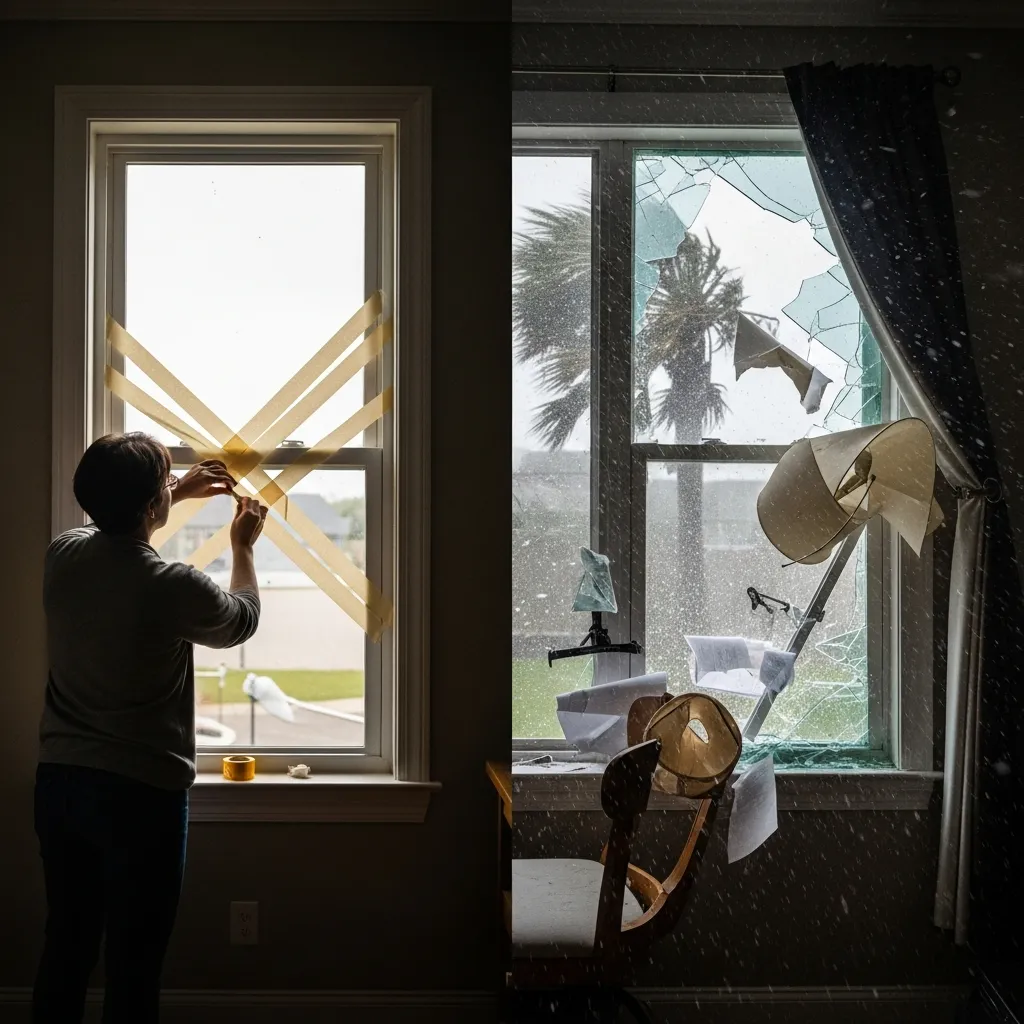
Your father taught you to tape the windows in an X pattern. Your neighbor showed you
the trick about cracking a window on the leeward side. Your uncle, the one who survived
Andrew, swore by half-inch plywood and a box of drywall screws. These were not
careless people. They were doing what they understood to be right, passing along what
they believed would keep their families safe.
This article is not about blaming them. It is not a gotcha piece designed to make you feel
foolish for following inherited advice. The people who taught you these methods were
working with the best information available to them at the time. Some of these practices
were even promoted in official hurricane preparedness brochures well into the 1980s.
But science advances. Building engineering advances. And what we know today about
how hurricanes damage homes — the cascading failure sequence described in the
previous article — reveals that several widely trusted preparation methods don't just fail
to protect. Some of them actively increase the danger.
What follows is not judgment. It is an update. Five methods, examined through the lens
of current research, with the same four-part structure for each: what you were told, why
it made sense, what the science actually shows, and what that means for you. The goal
isn't to take something away. It's to replace inherited assumptions with evidence — so
the decisions you make this year are based on what works, not what feels familiar.
Myth 1: “Tape Your Windows in an X Pattern”
What you were told: Apply masking tape or duct tape across your windows in an X or
asterisk pattern before a storm. The tape will hold the glass together if it breaks,
preventing dangerous shards from flying into your home.
Why it made sense: The logic is intuitive. Tape is sticky. Glass breaks into pieces. If
the tape holds the pieces together, they won't scatter. It's inexpensive, immediately
available, and gives you something physical to do while you wait for the storm. The act
of taping every window in the house feels like preparation. It feels like protection.
What the science shows: Tape does not strengthen glass. It does not increase impact
resistance. It does not prevent a window from breaking when struck by windborne
debris traveling at hurricane speeds. What tape does, according to NOAA's Hurricane
Research Division, is hold broken glass together in larger, heavier, more dangerous
shards. Instead of shattering into small fragments that disperse energy across a wide
area, taped glass breaks into consolidated pieces — jagged, heavy sections that become
more dangerous projectiles, not less. The Federal Alliance for Safe Homes launched an
entire public campaign — the "Go Tapeless'' initiative — specifically to combat this myth
after surveys found that seven in ten respondents still taped their windows before
hurricanes.
What this means for you: Taping windows is not a lesser form of protection. It is a
form of false confidence that consumes time and attention while providing zero
structural benefit. Every minute spent taping is a minute not spent on preparation that
actually works. If you have unprotected glass and a storm is approaching, plywood —
properly installed — is a better emergency measure than tape. But the honest answer is
that tape was never preparation. It was ritual.
Does Taping Windows Help in a Hurricane?
No. NOAA's Hurricane Research Division states directly that taping windows offers no
strength to the glass and no protection against flying debris. Tape holds broken glass
together in larger, more dangerous shards rather than allowing it to break into smaller,
less harmful pieces. The practice was included in official preparedness materials
decades ago but has since been identified as ineffective and potentially dangerous. The
Federal Alliance for Safe Homes actively campaigns against window taping. Effective
alternatives include hurricane shutters, impact-resistant windows, hurricane screens, or
properly installed plywood panels.
Myth 2: “Open a Window on the Leeward Side to Equalize Pressure”
What you were told: Open a window or door on the side of the house opposite the
wind. This allows air to flow through the structure and equalizes the pressure between
the inside and outside, preventing the house from ''exploding'' from internal pressure.
Why it made sense: The idea trades on a real phenomenon — internal pressurization
— but arrives at exactly the wrong solution. People understood, intuitively, that pressure
buildup inside a home during a hurricane was dangerous. The logical extension seemed
obvious: let the pressure out. Give it somewhere to go. The advice has the structure of
good engineering reasoning, which is partly why it persists.
What the science shows: This may be the single most dangerous myth on this list. As
the previous article in this series explained, internal pressurization is the primary
mechanism that causes roofs to separate from walls during a hurricane. It occurs when
the building envelope is breached — when wind enters through a broken window or
failed door. Opening a window deliberately creates the exact condition that leads to
catastrophic structural failure. You are not equalizing pressure. You are inviting the
storm inside your home. Wind entering through an open window generates upward
force against the roof from below while the hurricane's aerodynamic effects pull the roof
upward from above. Research from the Natural Hazards Center confirms that occupants
in multiple post-hurricane investigations reported roof loss occurring immediately after
windows or doors failed on the windward side. Opening them on purpose accelerates the
sequence.
What this means for you: Every opening in your home should be closed and sealed
during a hurricane. Every one. The building envelope's integrity is the single factor that
determines whether the cascading failure sequence begins. Opening a window doesn't
relieve pressure. It eliminates the barrier that was preventing catastrophic damage.
Should You Open Windows During a Hurricane?
Absolutely not. Opening windows during a hurricane introduces wind into the homes
interior, creating the internal pressurization that is the primary cause of roof separation
and cascading structural failure. The building envelope — the sealed barrier of walls,
roof, windows, and doors — must remain intact for a home to survive hurricane-force
winds. Post-hurricane investigations have consistently found that homes whose
envelopes were breached suffered dramatically worse damage than those that remained
sealed. Keep all windows and doors closed and secured.
Myth 3: “Plywood Will Protect My Windows”
What you were told: Buy sheets of plywood before the storm and screw them over
your windows. Plywood is strong, affordable, and available at any hardware store.
Why it made sense: This one is more complicated than the others, because plywood
can provide meaningful protection — under specific conditions. It is a legitimate
emergency measure recognized by the Florida Building Code as an acceptable form of
opening protection when installed correctly. The problem isn't plywood itself. The
problem is the gap between how plywood is supposed to be installed and how most
homeowners actually install it.
What the science shows: Effective plywood protection requires exterior-grade CDX
plywood at a minimum thickness of 5/8 inch. It requires panels cut to precise
dimensions for each opening, with at least four inches of overlap beyond the window
frame on all sides for masonry construction, or direct attachment to structural framing
members for wood-frame homes. It requires corrosion-resistant fasteners — not drywall
screws, not finish nails — spaced no more than 18 inches apart around the entire
perimeter, each penetrating at least two inches into structural material. Panels must be
pre-drilled and labeled for each specific opening. Oriented strand board — the cheaper
alternative that looks similar — degrades rapidly in coastal humidity and should not be
substituted. And critically, panels must be stored flat and dry between seasons to
prevent warping that compromises their fit.
What this means for you: Most DIY plywood installations fail at least one of these
criteria. Panels cut from memory rather than measured. Half-inch plywood instead of
5/8. Drywall screws that pull through under wind load. Panels attached to window
frames or siding rather than structural framing. Warped sheets that leave gaps where
wind can enter and catch. Each of these failures represents a potential envelope breach
— the same breach that triggers the cascading damage sequence. Plywood is a legitimate
last-resort option, but only when installed to engineered specifications. The honest
question isn't whether plywood works. It's whether your installation would pass a
building inspector's review.
Is Plywood Good Enough for Hurricane Protection?
Plywood can provide effective hurricane protection, but only when installed to specific
engineering standards. The Florida Building Code permits wood structural panels at a
minimum 7/16-inch thickness with a maximum 44-inch span between fastener lines.
However, most experts recommend 5/8-inch exterior-grade CDX plywood with
corrosion-resistant fasteners spaced every 18 inches, penetrating at least two inches into
structural framing. Panels must be pre-cut, pre-drilled, and labeled for each opening.
Most DIY installations fall short of these requirements, which significantly reduces their
effectiveness. Plywood is a legitimate emergency measure but not a substitute for
permanent, tested protection systems like hurricane shutters, impact windows, or
hurricane screens.
Myth 4: “My Home Survived the Last Hurricane, So It Can Survive the Next One”
What you were told: Nothing, exactly. This one isn't inherited wisdom. It's a
conclusion drawn from experience. Your home made it through Irma. Or Matthew. Or
the unnamed tropical storm that clipped your county three years ago. The house is still
standing. The logic seems self-evident: what survived once will survive again.
Why it made sense: Survival is powerful evidence. It is direct, personal, and visceral
in a way that statistics and engineering reports are not. If your roof held through 90-
mph winds, it feels unreasonable to question whether it would hold through the next
storm. This is the psychological mechanism known as survivor bias — the tendency to
draw broad conclusions from the subset of outcomes that happened to work, while
ignoring the conditions that made failure possible.
What the science shows: Storm exposure is cumulative, not binary. Every hurricane
subjects a home's structural connections to repeated cyclic loading — thousands of
pressure fluctuations over several hours. Roof-to-wall connections loosen. Fasteners
work against their anchoring material. Sealants around windows and doors degrade
with UV exposure, thermal cycling, and moisture infiltration between storms. A home
that survived a Category 2 storm may emerge from that storm structurally weaker than
it was before — with connection integrity compromised in ways that are invisible from
the ground. Additionally, no two hurricanes deliver identical forces. Wind speed,
direction, duration, the debris field generated by neighboring structures, and the
specific angle of approach all vary. A home that was on the weak side of a storm's
eyewall may face the strong side next time. A home that experienced sustained winds
may face wind gusts with higher peak pressures.
What this means for you: Past survival is not a structural assessment. It is an
outcome that was influenced by variables you cannot observe and may not have
controlled. The only way to know whether your home's structural connections remain
sound is to have them inspected. The only way to ensure your openings are protected is
to verify that protection exists. ''t survived last time'' is a memory, not an engineering
evaluation.
Myth 5: “I’ll Prepare When a Storm Is Coming”
What you were told: Watch the forecasts. When a storm enters the Gulf or turns
toward the coast, start preparing. You'll have three to five days of warning.
Why it made sense: For most of hurricane forecasting history, this was reasonable
advice. Storms developed gradually, followed relatively predictable tracks, and gave
coastal residents a window measured in days.
What the science shows: That window is closing. Rapidly. The National Hurricane
Center defines rapid intensification as an increase in maximum sustained winds of at
least 35 mph within 24 hours. In 2024 alone, the Atlantic recorded 34 separate rapid
intensification episodes — nearly double the ten-year average of 18. Hurricane Milton
strengthened by 90 mph in a single 24-hour period, escalating from Category 1 to
Category 5 faster than forecast models could track. Hurricane Helene intensified from
80 mph to 140 mph in the 24 hours before landfall. Climate Central data shows that
storms rapidly intensifying within 24 hours of landfall have grown five times more
frequent in the past seven years compared to the preceding 36-year period. Eighty
percent of all major hurricanes undergo rapid intensification at some point in their life
cycle.
What this means for you: The preparation model that assumes multiple days of
warning is increasingly unreliable. A storm that is a tropical depression on Monday
morning can be a major hurricane by Tuesday afternoon. If your protection plan
requires you to be physically present, with materials on hand, with time to install them,
you are relying on a forecast window that the atmosphere itself is compressing.
Permanent, pre-installed protection — systems that are ready before the first forecast is
issued — is not a luxury upgrade. It is the logical response to how storms actually behave
now.
How Much Time Do You Have to Prepare for a Hurricane?
Less than most people assume. While the National Hurricane Center issues watches 48
hours before anticipated tropical-storm-force winds, the increasing frequency of rapid
intensification means storms can escalate from minimal threat to major hurricane in
under 24 hours. In 2024, Hurricane Milton went from Category 1 to Category 5 in a
single day. Thirty-four rapid intensification episodes were recorded that season alone,
nearly double the recent average. Preparation that depends on forecast lead time —
buying plywood, installing shutters, hiring contractors — may not be possible when a
rapidly intensifying storm approaches. Pre-installed, permanent protection systems
eliminate dependency on the shrinking forecast window.
The Coping Vacuum
If you've read this far, you may feel something uncomfortable: the preparation methods
you knew have been removed, and nothing has replaced them yet. The tape doesn't
work. The open window makes things worse. The plywood might work, if installed
perfectly, which it usually isn't. Your home's past survival proves less than you thought.
And the time you assumed you'd have to prepare is shrinking.
That discomfort is not a design flaw of this article. It is the honest consequence of
removing false confidence before replacing it with real solutions. The next article in this
series begins the replacement.
Because the question is no longer whether to protect your home's openings. The
building science is settled. The failure cascade is understood. The myths have been
cleared. The question is now practical: What does effective protection actually look like?
What are the options? What do they cost? And when does the window to install them
close?
That window — the March-to-May preparation window before contractor demand
surges, material costs rise, and lead times extend into hurricane season — is the subject
of the next piece. Its the article where timing stops being abstract and becomes
personal.