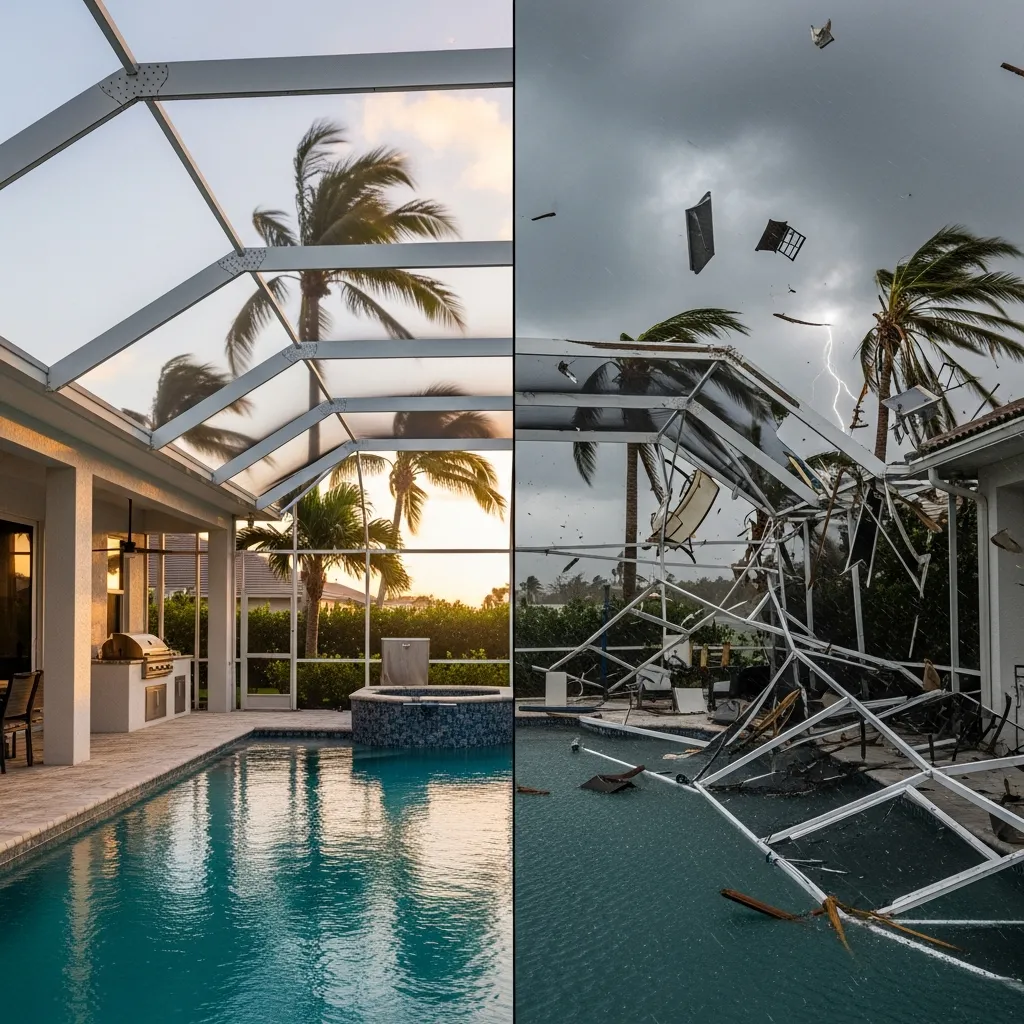
Your Lanai, Pool Cage and Outdoor Kitchen: The Most Expensive Hurricane Vulnerability on Your Property
YYour Lanai, Pool Cage and Outdoor Kitchen: The Most Expensive Hurricane Vulnerability on Your Property
The Space You Built for the Life You Wanted
You did not just build an outdoor kitchen. You built where Thanksgiving happens.
Where your family eats dinner three nights a week from April through October. Where
your children swim while you cook. Where your friends gather on Saturday evenings
while the sun drops behind the tree line and someone says, every single time, that this is
the best part of living in Florida.
You did not just install a pool cage. You installed the structure that makes your pool
usable, that keeps the leaves out and the no-see-ums away, that defines the boundary
between your outdoor living space and the elements that would otherwise make it
unbearable.
You did not just enclose a lanai. You created the room where the line between indoors
and outdoors dissolves — where you read in the morning, where the dog sleeps in the
afternoon, where the screened walls let everything in except the things you do not want.
These spaces represent more than construction. They represent an identity. The Florida
homeowner who lives outdoors. Who chose this climate and this home specifically for
what happens in the backyard. The outdoor living investment in a typical Florida home
ranges from $30,000 to $80,000 or more when you combine the lanai structure, the
pool cage, the outdoor kitchen, the patio, the landscaping, and the furnishings. High-
end properties routinely exceed $100,000 in outdoor living improvements. Florida is
one of just three states that account for more than a third of the entire outdoor kitchen
market in the United States. The outdoor living investment is not incidental to the
Florida lifestyle. It is the Florida lifestyle.
And every dollar of that investment is sitting in the most structurally vulnerable location
on your property.
Why These Spaces Are the First to Fail
The outdoor living spaces that Florida homeowners love most are, by design, the
weakest structures on their property. This is not a construction defect. It is a
consequence of what these structures are built to do.
Standard screen enclosures are not designed for hurricane winds.
A pool cage or lanai screen enclosure is designed to keep insects out and provide shade.
The aluminum framing is engineered for normal wind loads — typically rated for
sustained winds in the range of 100 to 140 mph depending on the local building code
and installation date. But a screen enclosure’s structural integrity depends on the
screens themselves remaining intact. When wind-borne debris tears a screen panel, the
enclosure loses its aerodynamic profile. Wind enters the structure, creates internal
pressure, and the forces that the framing was designed to resist are suddenly amplified.
A debris strike that creates a single large opening can lead to the collapse of the entire
enclosure.
This is precisely what happens in every major hurricane that strikes Florida. After
Hurricane Ian made landfall in 2022, entire neighborhoods in Lee and Charlotte
counties had their pool cages collapsed or stripped to bare aluminum. The same pattern
repeated after Hurricane Milton in 2024 across Sarasota and Manatee counties. The
screen fabric fails first. Then the structure fails because the engineering assumptions no
longer hold. Homeowners who assumed their pool cage would “hold up” were not wrong
about the framing. They were wrong about the screens. The screens were never designed
for debris impact, and once they fail, everything above them is compromised.
Outdoor kitchens are fully exposed to the cascade.
An outdoor kitchen built beneath a screen enclosure or pergola inherits every
vulnerability of that overhead structure. When the enclosure fails, the kitchen is exposed
to direct wind and debris impact. Stainless steel appliances can survive wind. Granite
countertops can survive rain. But cabinetry, electrical systems, plumbing connections,
and integrated features like beverage coolers, ice makers, and built-in grills are
vulnerable to water intrusion, debris impact, and structural shifting when the protective
structure above them collapses. The outdoor kitchen that cost $15,000 to $30,000 to
build can sustain damage that equals or exceeds the original construction cost.
The cascade damages the main home.
When an outdoor structure fails during a hurricane, the debris does not simply blow
away. The aluminum framing, the screen material, the furnishings, the detached
components — all of it becomes wind-borne debris that strikes the main home. Pool
cage aluminum has been documented wrapping around roof structures, puncturing
walls, breaking windows, and compromising the building envelope of the primary
residence. A collapsed pool cage generates dozens of individual projectiles — each
aluminum member, each bracket, each piece of hardware — that the wind drives into the
home at speeds that can penetrate standard glass and siding.
The failure of a $30,000 outdoor structure can directly cause $50,000 or more in
damage to the main home by breaching the envelope and allowing interior water
infiltration — the exact failure cascade this series has documented since Blog 2. Once a
window breaks from pool cage debris, wind-driven rain enters. Drywall, flooring,
cabinetry, electrical systems — the interior damage accumulates rapidly. And the
insurance claim becomes complicated by the wind-versus-water attribution dispute
documented in Blog 7. The outdoor structure’s failure does not just destroy the outdoor
space. It initiates the chain of events that destroys the interior of the home.
Are Screen Enclosures Hurricane Resistant?
Standard screen enclosures (pool cages, lanai enclosures, patio screens) are not
designed to resist hurricane-force winds with wind-borne debris. They are engineered to
keep insects out and provide shade under normal wind conditions, typically rated for
sustained winds of 100 to 140 mph depending on building code and installation date.
However, when debris tears a screen panel, the enclosure loses structural integrity as
wind enters and creates internal pressure that amplifies forces on the framing. This is
why pool cages and screen enclosures are consistently among the first structures to fail
during Florida hurricanes. Hurricane-rated motorized screens are a fundamentally
different product: engineered with aramid-fiber fabric, Keder track retention systems,
and independent certification to ASTM E1886/E1996 or Miami-Dade TAS 201/202/203
standards for wind-borne debris impact resistance.
The Financial Exposure Most Homeowners Have Not Calculated
The replacement costs for outdoor living components after a major hurricane are
significantly higher than the original construction costs, because post-storm demand
creates contractor shortages, material price surges, and wait times that can extend six to
twelve months.
Pool cage replacement: $15,000 to $47,000 or more depending on size, materials,
and design complexity. A standard replacement runs $33,000 to $47,000 for a full-size
enclosure with modern materials and current code compliance. After Hurricane Charley
in 2004, which destroyed an estimated 43,000 pool cages in the Charlotte-Lee County
corridor, homeowners waited twelve months or longer for replacement due to
contractor and material shortages.
Outdoor kitchen replacement: $15,000 to $50,000 or more depending on
appliances, materials, and configuration. High-end outdoor kitchens with built-in grills,
refrigeration, stone countertops, and integrated electrical and plumbing can exceed
$50,000 to rebuild. Appliance replacement alone — grills, coolers, sinks, ventilation —
often reaches $5,000 to $15,000.
Lanai structure replacement: $7,500 to $30,000 or more for a custom lanai with
screening, roofing, electrical, and flooring. Fully appointed lanais with upgraded
materials, lighting, fans, and integrated features can exceed $30,000.
Furnishings and accessories: $3,000 to $15,000 for quality outdoor furniture,
rugs, lighting, and décor. These items are rarely covered by homeowner’s insurance at
full replacement value.
The insurance picture compounds the financial exposure. Outdoor structures are often
covered under the “other structures” provision of a homeowner’s policy, which is
typically capped at 10 percent of the dwelling coverage limit. On a $400,000 policy, that
is $40,000 — which may not cover the full replacement of a pool cage, outdoor kitchen,
and lanai combined. The hurricane deductible still applies, meaning the first $8,000 to
$40,000 of that $40,000 coverage may come out of pocket. And depreciation can
reduce the payout further, especially for structures that are more than five years old.
The total financial exposure for a Florida homeowner with a well-developed outdoor
living space is not $30,000 to $80,000. It is $30,000 to $80,000 in replacement costs,
minus whatever insurance actually pays after deductibles and depreciation, plus six to
twelve months without the space while waiting for contractors, plus the potential
cascade damage to the main home. For many homeowners, the out-of-pocket exposure
after a major hurricane exceeds the cost of permanent protection by a factor of two to
three. And unlike permanent protection, this exposure resets to zero after the
destruction — you pay to replace what was destroyed, with no guarantee it will survive
the next storm.
How Much Does It Cost to Replace a Pool Cage After a Hurricane?
Replacing a pool cage after hurricane damage costs $15,000 to $47,000 or more in
Florida, depending on the enclosure’s size, height, screening material, and design
complexity. Standard full-size replacements with current code-compliant materials
average $33,000 to $47,000. After major hurricanes, replacement costs increase further
due to contractor shortages and material demand surges, and wait times can extend 6 to
12 months. Insurance coverage for pool cages typically falls under the “other structures”
provision of a homeowner’s policy, which is usually limited to 10 percent of the dwelling
coverage. The hurricane deductible applies before any payout, and depreciation can
further reduce the claim. Many homeowners discover that insurance covers only a
fraction of the actual replacement cost.
What Actually Protects These Spaces
The structural vulnerability of outdoor living spaces creates a problem that standard
hurricane preparation cannot solve. You cannot board up a lanai. You cannot shutter a
pool cage. You cannot carry a 20-foot screen enclosure into the garage.
This is the specific problem that motorized hurricane screens were engineered to
address.
A motorized hurricane screen system installed on an outdoor living enclosure serves a
fundamentally different function than the standard insect screening it replaces. Where
standard screening is designed to keep bugs out, hurricane-rated motorized screens are
independently tested and certified to the same ASTM E1886/E1996 and Miami-Dade
TAS 201/202/203 standards that apply to windows and doors. The aramid-fiber fabric
absorbs debris impact. The Keder track retention system holds the fabric in place under
sustained hurricane-force wind pressure. The motorized deployment means the entire
enclosure can be sealed in minutes, from a remote control or a smartphone.
What makes motorized screens uniquely suited for outdoor living spaces is the dual-use
value they provide. A hurricane shutter can protect a window, but it serves no function
outside of storm season. A motorized screen system deployed on a lanai or pool cage
provides daily benefits: insect protection without chemical sprays, UV reduction that
protects furnishings and skin, solar heat management that extends the comfortable
hours on your patio, rain protection in afternoon thunderstorms, wind attenuation on
breezy evenings, and privacy from neighboring properties. When hurricane season
arrives, those same screens deploy as certified hurricane protection. One investment
serves both purposes. The homeowner who uses their screens three hundred days a year
for comfort and three days a year for hurricane protection is getting daily return on an
investment that also eliminates their most significant structural vulnerability.
The aesthetic consideration is equally important for outdoor living spaces. Homeowners
who invested $30,000 to $80,000 in creating beautiful outdoor environments do not
want that beauty compromised by permanent storm hardware. Motorized screens
retract into compact cassette housings that are minimally visible when not deployed.
When retracted, the outdoor space looks exactly as it did before the screens were
installed. When deployed, the screen fabric is translucent rather than opaque — the
space is protected but not entombed.
For homeowners who have already invested significantly in outdoor living, the financial
case is direct. The cost of a motorized hurricane screen system for a typical outdoor
enclosure ranges from $15,000 to $35,000 — a fraction of the replacement cost for the
outdoor space it protects, and a fraction of the cascade damage it prevents to the main
home. When combined with the daily-use benefits that extend the outdoor space’s
usability and the wind mitigation insurance credits that reduce premiums annually, the
investment math works in every direction.
How Do I Protect My Lanai from a Hurricane?
To protect a lanai from hurricane damage, install certified hurricane-rated protection on
all openings. The most effective option for outdoor living enclosures is motorized
hurricane screens, which are engineered with aramid-fiber fabric and Keder track
retention systems certified to ASTM E1886/E1996 or Miami-Dade TAS 201/202/203
standards. Unlike standard insect screens, hurricane-rated motorized screens absorb
wind-borne debris impact and maintain structural integrity under sustained hurricane-
force winds. They deploy in approximately 60 seconds per opening via remote control,
wall switch, or smartphone. Alternative approaches include removing all furnishings
and loose items before a storm (reducing secondary debris risk) and reinforcing the
structural connections of the enclosure itself, though neither approach provides the
debris-impact resistance of certified hurricane screens. Standard screen enclosures
cannot be meaningfully reinforced against hurricane-force debris.
The Space That Defines How You Live
If you are reading this series in sequence, you have spent eleven articles building a
complete understanding of hurricane preparation. You understand the psychology of
delay and why most homeowners wait too long. You understand building envelope
science and why openings are the critical failure point. You understand the insurance
landscape and why coverage gaps are structural, not accidental. You understand the
testing standards that separate genuine certification from marketing language. And now
you understand why the outdoor living spaces that define your Florida lifestyle are the
most vulnerable and most valuable targets on your property.
One article remains. It addresses the single question that everything in this series has
been building toward: the choice between permanent protection and the annual
scramble. Between pressing a button and climbing a ladder. Between making one
decision that serves you every season and making the same anxious, time-pressured
decisions every June.
That choice is personal. It involves your budget, your priorities, your tolerance for risk,
and your vision for how you want to experience every hurricane season for as long as
you own your home. The final article in this series lays both paths side by side — the cost
of each, the experience of each, and the outcome of each — so the decision is yours to
make with complete clarity.