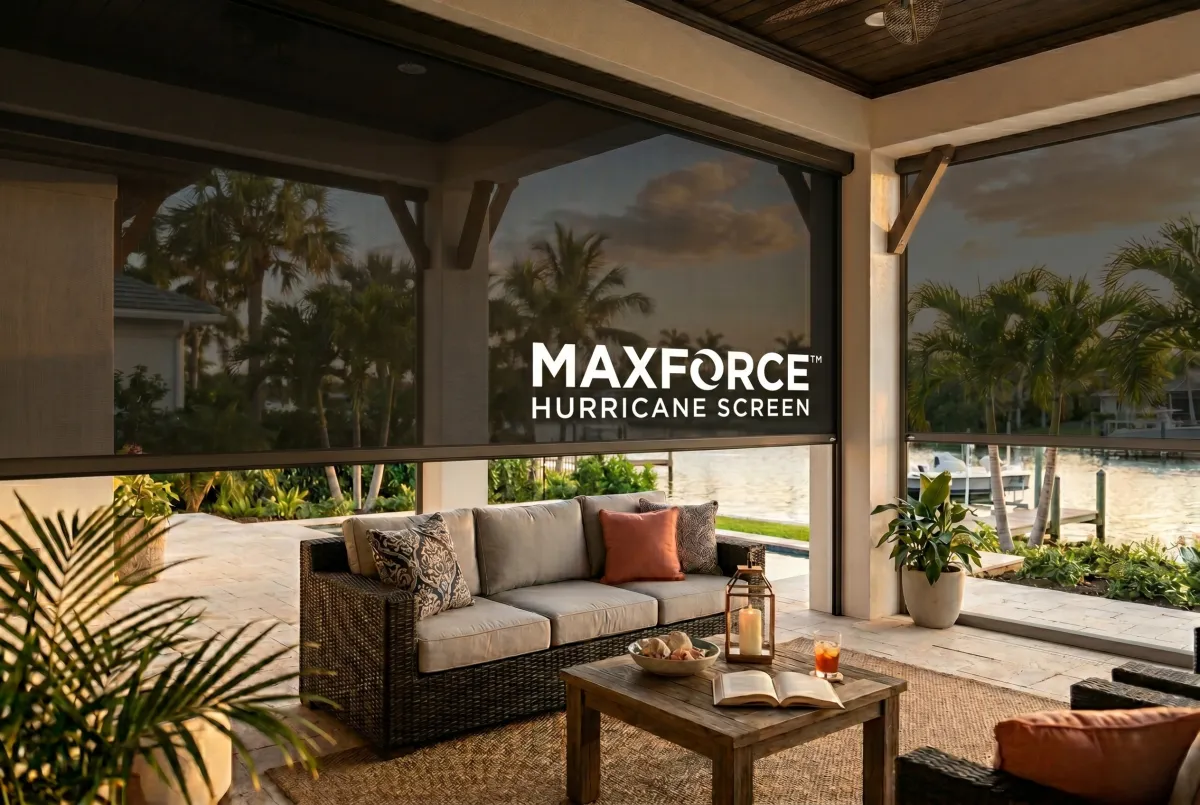
MaxForce™ Hurricane Screens | Proven Florida Wind Protection
Why MaxForce Hurricane Screens: Proven Wind Protection, Built in America
Quick Answer: MaxForce Hurricane Screens are motorized retractable screens engineered for storm-grade wind protection and everyday outdoor living. The system meets the engineering standards for Miami-Dade County and is engineered for use in the High-Velocity Hurricane Zone (HVHZ) at winds up to 185 mph. It is manufactured in the United States by Fenetex (in operation since 2007) and installed through a vetted dealer network across Florida and beyond. For homeowners who want hurricane protection without giving up light, view, or daily comfort, MaxForce is built to do both.
What MaxForce Actually Is
Most outdoor living products ask you to choose. A fixed shutter protects, but seals you in. A retractable awning shades but folds at the first strong gust. A standard insect screen invites the breeze but stops nothing larger than a mosquito.
MaxForce was built to end that trade-off.
MaxForce Hurricane Screens are motorized screens that retract into a low-profile housing and deploy on demand — shade and ventilation on an ordinary Tuesday, a sealed defensive barrier when a storm turns toward the coast. They run on Somfy or Gaposa motors, integrate with the Bond Bridge Pro app and the Fenetex remote-access smart-home RF platforms, and disappear when you don't need them. As outdoor living products go, they belong to a small category that performs two jobs at once: comfort engineering for daily use, and engineered wind protection when the forecast demands it.
The latest generation makes that second job feel as easy as the first. For years, the screen rode on a fixed track — storm-strong, but stiff in a way you noticed every day. The current MaxForce trades that fixed track for a self-adjusting one: a spring-tension system that keeps the fabric taut across nearly an inch of travel, lets it sit close to flat when it's down, and stays quiet when the wind comes up. The strength didn't change. What changed is everything around it. The screen you trusted in a storm is now the screen you actually want open the rest of the year.
That dual purpose is the whole point. It is also what separates MaxForce from the broader field of retractable screens sold across Central Florida and the Gulf Coast, most of which are rated for comfort and nothing more.
Why MaxForce Is Built Well
Good marketing claims durability. Engineering documentation proves it. Here is what the MaxForce platform is built on, drawn from confirmed manufacturer specifications:
The engineering standard is the part worth lingering on. Miami-Dade County writes the most demanding building code in the United States, the code for the High-Velocity Hurricane Zone, where Florida's storms make landfall first and hardest. MaxForce is engineered to meet those standards and built for use in the HVHZ at winds up to 185 mph. That is a deliberate design target, not a marketing flourish: the system was conceived from the start for the conditions most screens are never asked to face.
That is the difference between a screen that should hold and one engineered for the place the wind hits hardest.
Two newer details are worth knowing. The track is now self-adjusting: a spring-tension system keeps the screen taut across its full range instead of leaning on a rigid fixed track, and it does the quiet work of staying composed when conditions shift: Absorbing each gust the way a car's shocks soak up a pothole, rather than letting the screen snap and rattle against its housing. Then, when a real load arrives, a patented prong-and-receiver design locks the inner track into the outer one, no extra clips or sleeves required. That lock is where the storm strength lives.
Why MaxForce Is Proven
Specifications describe what a product is supposed to do. Installations across two decades describe what it has actually done.
MaxForce screens, manufactured by Fenetex, protect homes and commercial properties along the most storm-exposed coastlines in the country and well beyond. The platform has been specified for landmark commercial installations and resort properties, which means it has met the procurement standards of organizations that do not gamble on unproven hardware.
The dealer record tells the same story in plainer language. A 22-year veteran of the retractable-screen trade put it directly after installing the system: "Hands down the best system so far." Another installer reported completing twelve MaxForce projects across single, dual, vinyl, and insect configurations — the range itself a kind of proof, since a fragile product does not survive that many variations of real-world use. A dealer of fifteen years described a five-screen installation on a home built at the top of an exposed ridge in the Bahamas, a location that punishes anything less than purpose-built.
These are not testimonials a copywriter invented. They are the verdicts of people who install storm protection for a living and stake their own reputations on it.
Why MaxForce Is Trustworthy
In this category, trust is not a feeling. It is the answer to three concrete questions: Who made it? Where? And what happens when something goes wrong?
Who and where: MaxForce screens are manufactured by Fenetex, an American company that has been building motorized screens since 2007 from its Jacksonville, Florida, operation. That matters more than it sounds. Domestic manufacturing means the people who engineer the product are reachable, the supply chain is accountable, and a screen ordered today is built to the same standard as one ordered a decade ago. Backward compatibility — the ability to service and match an installation years after it goes up — is quite a differentiator that most importers cannot offer.
What happens when something goes wrong: The MaxForce platform carries a lifetime warranty, and the service experience that comes with it is what customers tend to remember. One homeowner, not the most technical person by his own admission, described a support technician who made a fix simple and stayed with him until it was resolved. A long-time partner summarized it without embellishment: top-notch customer service, top-notch products. A homeowner with a 24-foot screen installed for over a year reported that it "operates flawlessly," holding out rain, dirt, debris, and sun without complaint.
A company is trustworthy when the experience after the sale matches the promise before it. By the record, MaxForce clears that bar.
Why MaxForce Is Reputable
Reputation is what other people say when you are not in the room. For MaxForce — and for Fenetex, the manufacturer of record — the people in the room are dealers, installers, and homeowners who keep coming back.
The dealer network is the backbone of that reputation. Hurricane screens in Florida are not a mail-order purchase; they are a regulated installation that requires a credentialed contractor to pull a permit and meet code. MaxForce routes its work through vetted dealers who carry those credentials, which is precisely why homeowners searching for motorized hurricane screen dealers near me are matched to installers qualified to do the job legally and correctly, not whoever happens to bid lowest.
That network spans the storm-exposed markets where these screens matter most. A Central Florida dealer specializing in retractable screens across Central Florida describes Fenetex as a company that produces high-quality screens and stands behind them with outstanding service. Partners measure their relationships with the manufacturer in years and decades, not project cycles — fifteen years, in more than one case. Reputation does not accumulate that way by accident.
Why MaxForce Stands Apart in Its Category
Put the pieces together, and the case for MaxForce is not a slogan — it is an inventory.
It is one of the few motorized screens engineered to meet the country's strictest hurricane-code standards while still lying nearly flat and running quietly for daily shade and ventilation. It is built in America by a manufacturer that has been in continuous operation since 2007, not assembled from imported parts of unknown origin. It is backed by a lifetime warranty and a service record that homeowners and installers describe in the same word — flawless. And it is installed by a credentialed dealer network that protects buyers from the single biggest risk in storm protection: a beautiful screen, installed wrong, that fails when it is finally tested.
No honest brand can promise that a storm will spare a home. What MaxForce can promise is that the screen between the wind and the family was engineered, manufactured, and installed by people who treated the job as if their own names were on it. By the verdict of the people who install storm protection for a living, it is — to borrow their phrase — the best system they have used.
That is not a claim MaxForce has to make about itself. It is one that its customers keep making for it.
Frequently Asked Questions
Are MaxForce screens rated for hurricanes? Yes. MaxForce Hurricane Screens are engineered to meet Miami-Dade County engineering standards. They are built to withstand winds up to 185 mph in the High-Velocity Hurricane Zone (HVHZ) under the Florida Building Code. Hurricane installations require a licensed contractor to pull a permit.
Where are MaxForce screens made? MaxForce screens are manufactured in the United States by Fenetex, in Jacksonville, Florida. The company has been building motorized screens since 2007.
Can MaxForce screens be used every day, not just during storms? Yes. and the latest generation is built for it. The self-adjusting track lets the screen lie nearly flat and run quietly, so it works as an everyday screen for shade, ventilation, insect protection, and up to 95% UV blocking, then seals into a storm-ready barrier when needed. It runs on Somfy motors and integrates with major smart-home systems.
What's new in the latest MaxForce? The current MaxForce replaces the older fixed track with a self-adjusting, spring-tension track. It keeps the screen taut across its full range, lays nearly flat when deployed, and runs noticeably quieter in wind — all while keeping the same hurricane strength. It is also backward compatible with existing MaxForce systems, so it fits into installations already on the wall.
How do I find a MaxForce dealer near me? MaxForce installs through a credentialed dealer network across Florida and additional markets. Because hurricane installations require a permitted, code-compliant install, leads are matched to dealers qualified to perform the work legally — so a search for motorized hurricane screen dealers near me connects you with installers who can pull the permit and meet code.
What warranty comes with MaxForce screens? MaxForce screens carry a lifetime warranty.
Find Your MaxForce Dealer
Storm protection is only as good as the installation behind it. To see whether MaxForce Hurricane Screens are right for your home, and to connect with a credentialed dealer in your area, visit Maxforcescreens.com.
Certified MaxForce Dealers Across Florida
MaxForce is installed by a network of certified, credentialed dealers, each serving its own stretch of the state. Find the one nearest you:
Titan Shutters and Screens — St. Augustine, FL. Serving Palm Coast to Jacksonville. View their MaxForce page.
Florida Living Outdoor — Oviedo, FL. Serving Central Florida, from New Smyrna Beach to Melbourne, plus Fort Lauderdale and Palm Beach County. View their MaxForce page.
Screens N' More — Stuart, FL. Serving Vero Beach to Palm Beach Gardens. Visit their site
Aluminum Building Supplies — Northwest Florida. Serving Pensacola to Panama City Beach. View their MaxForce page
Brannan Aluminum — Panama City Beach, FL. Serving Panama City Beach to Tallahassee. Visit their site
One screen. Every season. Every storm.