What MaxForce™ 365 Means: One Screen for Every Day
What "365" Actually Means: A Screen for Every Day of the Year, Not Just the Worst One
Most numbers in a product name are decoration. A model year. A version. A figure chosen because it sounds modern on a spec sheet. The 365 in MaxForce 365 is none of those things. It is a count — the number of days in a year — and it is a claim about how many of them the screen is built to matter on.
For nearly two decades, the honest answer to a simple question —how many days a year does a hurricane screen actually earn its keep?— was a small one. One, in a quiet year. A handful, in a bad one. The rest of the time, it waited. The new product was designed to change that answer to match its name. Not by softening the storm protection, which stayed exactly where it was, but by building three separate jobs into a single system — so the screen is doing something useful nearly every day you own it.
The launch announcement introduced the idea. This post explains the substance behind it: the three pillars the number stands for, what each one delivers, and why a screen engineered around all three behaves differently than one engineered around any single one.
Quick Answer
What does the "365" in MaxForce 365 stand for?
The 365 stands for the days in a year — and the promise that the screen is built to be useful on nearly all of them, not just during a storm. It rests on three pillars: daily comfort (up to 95% UV blocking, insect, dust, and rain control, and two-way privacy on a quiet, phone-controlled system); year-round readiness (the screen is already installed and in everyday use, so protection is passive and always present); and storm-grade protection (the same 185 MPH wind zone engineering that MaxForce has always delivered). One system, three jobs, every day of the year.
A Name That Is a Specification, Not a Slogan
There is a meaningful difference between a screen designed for one day a year and a screen designed for all of them, and it is not a difference of degree. It is a difference of kind. A storm-only screen is engineered backward from a single worst-case scenario: maximum wind load, maximum debris, maximum stress. Every design decision serves that one extreme, and the everyday experience — how quietly it runs, how smoothly it deploys, how pleasant it is to use on a calm Tuesday — is whatever happens to be left over after the storm requirements are met.
A screen designed for 365 days is engineered forward from the way people actually live with the thing. It still has to pass 185mph wind zone testing — that requirement never relaxes — but it also has to be worth touching on the other three hundred and sixty-four. Those are different design briefs, and for most of the category's history they have lived in different products: a storm screen here, a bug screen there, a solar shade somewhere else. MaxForce 365 is the rare case where the number on the name describes what the engineering set out to do, rather than what the marketing wished were true.
Pillar One: Daily Comfort
Start with the pillar that does the most work, because it does it most often. On the roughly 360 days a year when there is no storm anywhere near you, a MaxForce 365 screen is solving the ordinary problems that quietly decide whether an outdoor space gets used or abandoned.
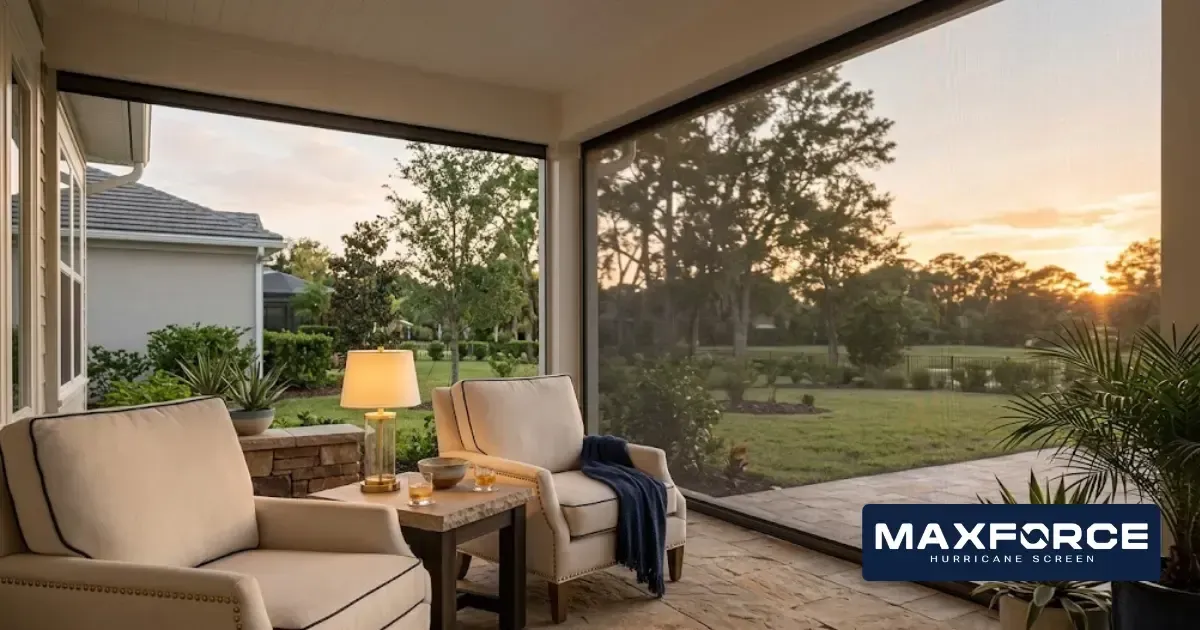
It manages the sun. The fabric blocks up to 95% of the sun's UV rays, which does three things at once: it drops the radiant heat that turns a west-facing patio into a furnace at four o'clock, it kills the glare that makes a book impossible to read and a conversation a squint, and it protects furniture and flooring from the slow bleaching that direct exposure inflicts. It keeps out the insects — the mosquitoes at dusk, the no-see-ums, the things that end an evening outdoors before it has properly started. It gives you privacy through a two-way-mirror effect: you see out, your neighbors do not see in. It handles dust, rain, and blowing debris. And it does all of this quietly, because the new self-adjusting spring-retention track keeps the fabric under even tension as the day heats and cools, so the screen runs smoothly and operates without the noise that plagues lesser systems — controlled from your phone, your voice assistant, or your home-automation system.
None of those functions is dramatic. That is exactly the point. Daily comfort is the accumulation of small frictions removed — the evening you stay outside instead of retreating indoors, the afternoon the patio stays usable, the dinner that is not surrendered to mosquitoes. Multiply those across a year and the screen has paid for itself in lived experience long before a storm ever tests it.
Pillar Two: Year-Round Readiness
The second pillar is the one homeowners feel most acutely the first time a storm is in the forecast and they have nothing to do about it. Because MaxForce 365 is already installed, already integrated into the house, and already part of the daily routine, readiness is passive. There is no scramble. Nothing to dig out of the garage at the last minute. Nothing to bolt on in the rain while the lines at the hardware store grow. No ladder, no hardware, no question of whether you started early enough.
This is the quiet advantage of a screen you use every day: it is never in the wrong state. A storm panel that lives in storage is, by definition, not protecting anything until someone installs it — and the moment that matters most is the moment that installation is hardest. A screen that has been managing your sun and your insects all summer is already in place, already tested by daily use, and ready to deploy the instant the wind picks up. Readiness stops being a task on a checklist and becomes a property of the system itself.
Pillar Three: Storm-Grade Protection
The third pillar is the one MaxForce was born with, and it did not move an inch. MaxForce 365 carries the same engineering for meeting the High Velocity Hurricane Zone standard — the most demanding residential hurricane code in the country. The hybrid ballistic fabric, the powder-coated aluminum, the sealed and locked fabric edge that keeps the screen in its track under load: all of it carries forward.
A later post in this series takes the certifications apart in plain English — what 185 MPH actually means, what the testing involves, and why the approvals matter. For now, the essential point is one of sequence: the storm protection is not a feature added to a comfort product. It is the foundation the comfort is built on. Daily comfort and year-round readiness are only worth anything because the thing delivering them is tested and certified for the 185mph wind zone. Strength first; everything else stands on it.
Why All Three at Once Changes the Math
Here is the part that is easy to miss. For most of the category's history, a homeowner who wanted all three of these things had to assemble them. A bug screen for the summer. A solar shade for the sun. A separate storm product for the hurricane. Three systems, three installations, three sets of hardware crowding the same opening — and three compromises, because each product did its one job and ignored the other two.
MaxForce 365 collapses that into one system on one track behind one brand. That is not merely tidier. It changes both the economics and the experience. The economics, because a single integrated system costs less to buy, install, and maintain than three separate ones — and because the everyday value accrues every day rather than sitting idle in three different forms. The experience, because there is nothing to coordinate: the same screen that filtered your afternoon sun and kept the mosquitoes out at dinner is the screen that locks down for the storm. One decision replaces three. One opening does the work of what used to take a committee of products.
The table below puts the three pillars side by side.
A screen built for a single day is equipment you store. A screen built for 365 is a room you live in — one that also happens to stop a hurricane.
What the Series Looks at Next
The three pillars are thewhat. The next post, publishing June 15, gets to thehow— the single engineering change that made all three possible at once. It looks inside the side track at the self-adjusting spring-retention system that replaced the older fixed track, why that change is the difference between a screen built for the storm and a screen built for the year, and how a shock-absorber works as the right way to picture it. MaxForce 365 launches June 1, 2026, and orders open June 19. If you want to understand the product before you make a decision, this series is built to be read in order — and the engineering is where the story gets concrete.
Frequently Asked Questions
What does the "365" in MaxForce 365 mean?
The 365 refers to the days in a year and signals that the screen is designed to be useful on nearly all of them, not just during a storm. It rests on three pillars: daily comfort (UV, insect, dust, rain, and privacy control), year-round readiness (always installed and ready, with nothing to deploy at the last minute), and storm-grade protection (185 MPH tested and certified, Florida Product Approval FL8637-R15). It is one system that does the work that used to require three separate products.
What are the three pillars of MaxForce 365?
Daily comfort, year-round readiness, and storm-grade protection. Daily comfort covers the everyday functions — up to 95% UV blocking, insect and dust control, and two-way privacy on a quiet, phone-controlled system. Year-round readiness means the screen is already installed and in use, so storm protection is passive and present rather than something to scramble to deploy. Storm-grade protection is the 185 MPH tested and certified hurricane defense, under Florida Product Approval FL8637-R15, that has always defined MaxForce, and it is the foundation the other two are built on.
Do I need separate screens for bugs, sun, and storms?
Not with MaxForce 365. For much of the category's history, homeowners assembled three different products — an insect screen, a solar shade, and a separate storm system — each doing one job and crowding the same opening. MaxForce 365 integrates those jobs into a single motorized system on one track. That consolidation lowers the total cost to buy, install, and maintain, and it removes the need to coordinate multiple products on the same space.
Is a year-round screen really better than a storm-only screen?
For most homeowners, yes — for two reasons. First, value: a storm-only screen sits idle the roughly 360 days a year there is no storm, while a year-round screen is delivering comfort and utility the entire time. Second, readiness: a screen already installed and in daily use is in place and ready the instant a storm appears, with no last-minute deployment. A year-round system earns its keep continuously and is never caught in the wrong state.
Does using the screen every day affect its hurricane readiness?
No — the opposite. The self-adjusting spring-retention track is engineered for continuous use and keeps the fabric under even tension through daily temperature and humidity cycles, which is part of why the system runs quietly and needs fewer service calls. Daily use keeps the screen exercised and verified, so any issue surfaces during an ordinary week rather than during a storm. The hurricane rating is unchanged by everyday operation, and the lifetime warranty stands behind the system.