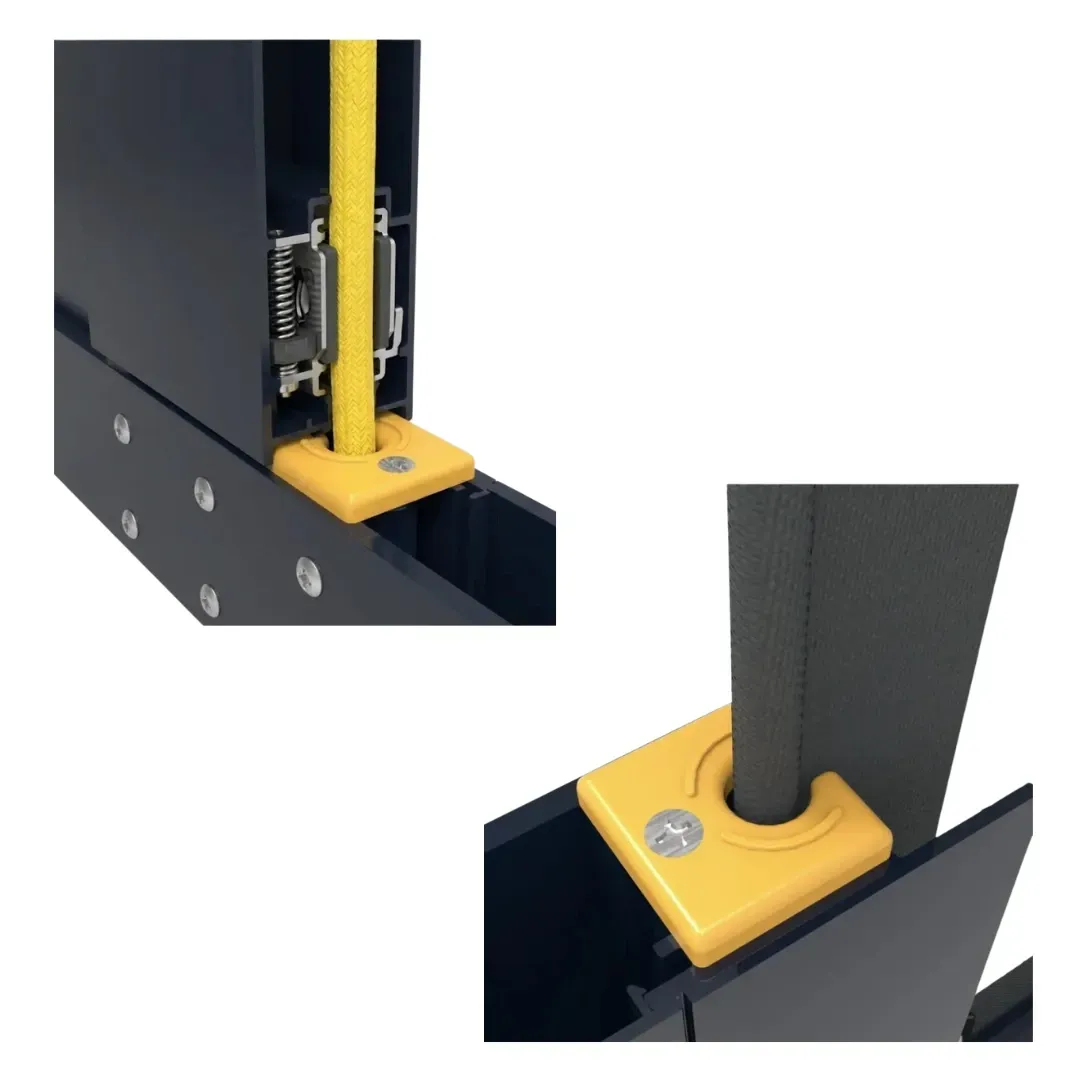
How the MaxForce™ 365 Self-Adjusting Track Works
Built for the Storm, Engineered for the Other 360 Days: The Self-Adjusting Innovation
The change that makes MaxForce 365 what it is would not survive a photograph. You cannot see it from the patio. It is not in the fabric, not in the frame, not in the motor. It lives inside the side track — a few inches of engineering most homeowners will never look at, and the entire reason the screen now behaves the way it does.
The first two posts in this series made a promise: that MaxForce 365 delivers daily comfort, year-round readiness, and storm-grade protection from a single system. This post is where that promise gets concrete. All three pillars rest on one engineering decision — the move from a fixed track to a self-adjusting, spring-retention one. Understand that single change and you understand the product.
If you are arriving here mid-series, the launch announcement sets the stage and the three-pillar piece explains thewhat. This is thehow.
Quick Answer
How does a self-adjusting screen track work?
A self-adjusting screen track uses a spring-retention system to hold the fabric under constant, even tension as conditions change. Heat and humidity make fabric and metal expand and contract over the course of a day; a fixed track holds one setting and lets the fabric go slack or bind, while the spring system continuously takes up or releases tension — the way a shock absorber smooths a road that a rigid axle would transmit straight to the cabin. The result is a screen that deploys smoothly, runs quietly, and stays correctly tensioned in any weather, without giving up storm-grade strength.
The Problem Every Retractable Screen Has to Solve: Tension
A retractable screen is, at heart, a large panel of fabric that has to be pulled flat across a wide opening and held there. Tension is everything. Too little, and the fabric ripples, sags, and flaps — letting wind, light, and insects slip around the edges. Too much, and it strains the seams, the motor, and the track, wearing the whole system and risking tears. Correct tension is a narrow target, and the entire performance of the screen depends on hitting it.
The difficulty is that the target moves. Fabric and aluminum expand in heat and contract in cold. Humidity changes how the fabric behaves. A screen tensioned perfectly at seventy degrees on a cool morning is a measurably different screen at ninety-five degrees the same afternoon. Holding the right tension across that daily range — and across the seasons, and across years of use — is the central engineering problem of a motorized screen. Everything else is downstream of how well a system solves it.
What a Fixed Track Did Well — and Where It Stopped
For nearly two decades, MaxForce solved that problem with a fixed track and a heavy weight bar — and solved it impressively. A fixed track is exactly what it sounds like: a rigid channel that captures the fabric edge with brute mechanical certainty. Paired with one of the heaviest weight bars in the category, it produced a screen that simply did not move under load. In 185mph wind zone testing, that rigidity is a virtue. There is no give, nothing to flex, nothing to work loose.The fixed track earned MaxForce its reputation, and for pure storm performance it never needed improving.
But rigidity is a single setting. A fixed track holds the same way at every temperature, in every season, which means it cannot accommodate the daily expansion and contraction the fabric and frame go through. Over a hot afternoon the fabric could go slightly slack; on a cold morning it could pull tighter than intended. The system was tuned for the worst day, and on ordinary days that tuning showed up as the small frictions a storm screen carries — a touch of binding, a little chatter, a fabric edge working harder than it had to. Strong, undeniably. Static, also undeniably. The strength was never the limitation. The lack of adjustment was.
The Self-Adjusting Spring-Retention Track
MaxForce 365 keeps the strength and removes the rigidity. A self-adjusting, spring-retention track replaces the fixed channel. Instead of holding one fixed tension, the spring system stores and releases tension continuously — taking up slack as the fabric expands, easing off as it contracts. It is always finding the correct setting, because the setting is no longer a single point. It floats with conditions.
The cleanest way to picture it is a shock absorber. A rigid axle is strong, but it sends every bump in the road straight into the cabin. A shock absorber carries the same load and smooths the ride, absorbing and releasing energy as the surface changes. The fixed track was the rigid axle: superb under one extreme, unforgiving of everything else. The spring-retention track is the shock absorber: it carries the storm load when it has to, and the rest of the time it quietly absorbs the daily expansion and contraction that used to make a screen bind and chatter.
That one change cascades into everything a homeowner actually notices. Even tension means the screen deploys smoothly, with no sticking on the way up or down. Even tension means it runs quietly — the springs hold the fabric steady, so there is no flutter and no noise to interrupt a quiet evening. Even tension means less wear on the fabric, the seams, and the motor, which is why a self-adjusting system needs far fewer service calls than a storm-tuned one. The engineering is invisible. The experience is the opposite of invisible — it is the difference between a screen you tolerate and a screen you forget is working.
The Locked Keder Edge: Why the Fabric Stays Put
Tension is only half the story. The other half is how the fabric edge is held in the track to begin with — and here MaxForce uses a keder edge. A keder is a sealed bead sewn into the edge of the fabric that feeds into a matching channel in the track and locks there along its entire length. The idea comes from sailboat rigging, where a sail's edge is fed into a mast track and held under enormous load without tearing free. There are no zippers to split, no snaps to pop, no loose edges for wind to grab.
That locked edge is why a MaxForce screen stays in its track even in high winds, and it is also why the everyday experience is so clean. A sealed edge does not leak insects around the sides, does not flutter in a breeze, and does not blow out. The keder lineage carries straight into MaxForce Hurricane Screens, now working in concert with the spring-retention system: the edge is locked and properly tensioned at the same time, in every condition. The fabric is captured; the tension is managed. Together, those two things are the screen.
Strong in the Storm, Gentle on a Tuesday
Here is why all of this matters: for the first time, one track does both jobs without compromise. The spring-retention system carries the storm load through the locked keder edge and the heavy bar, and on the three hundred and sixty ordinary days it absorbs the small daily changes a fixed track could not. Homeowners used to face a real choice — a screen tuned for the storm, heavy and a little fussy day to day, or a screen tuned for daily ease that could not be trusted in a hurricane.
MaxForce 365 refuses that choice. The strength is still there — engineered for use in HVHZ or High-Velocity Hurricane Zones. What changed is that the strength now arrives with a track that adapts, so the same system that’s tested and certified for the 185mph wind zone is the one that runs silently while you read on the patio in July.The table below sets the two approaches side by side.
A fixed track is a rigid axle — magnificent under one extreme load, unforgiving of everything else. A spring-retention track is a shock absorber: it carries the storm and smooths the year.
What the Series Looks at Next
The engineering explainswhya MaxForce 365 screen can run in silence. The next post, publishing June 22, is about what that silence is actually worth — the daily experience of a screen that deploys without a sound, the difference even tension makes on an ordinary evening, and why quiet operation is one of the most underrated features a motorized screen can have. MaxForce 365 launches June 1, 2026, and orders open June 19. The track is where the product's character is decided; the next piece is where you start to feel it.
Frequently Asked Questions
How does a self-adjusting screen track work?
It uses a spring-retention system to keep the fabric under constant, even tension as conditions change. Because fabric and metal expand in heat and contract in cold, a screen's ideal tension shifts through the day. A fixed track holds a single setting and lets the fabric go slack or bind; the spring system continuously takes up or releases tension to match conditions — like a shock absorber smoothing a road instead of a rigid axle transmitting every bump. The screen deploys smoothly, runs quietly, and stays correctly tensioned in any weather.
What is a keder edge on a retractable screen?
A keder edge is a sealed bead sewn into the edge of the screen fabric that feeds into a matching channel in the side track and locks there along its full length. The concept comes from sailboat rigging, where a sail's edge is held in a mast track under heavy load without tearing free. On a screen, the keder edge means there are no zippers to split and no loose edges for wind to catch, so the fabric stays locked in its track — even in high winds — and the sides do not leak insects or flutter.
What is the difference between a fixed track and a self-adjusting track?
A fixed track holds the fabric at one rigid setting. It is extremely strong under storm load but cannot adapt to daily temperature and humidity changes, so the fabric can go slack or bind and the screen can chatter or stick in ordinary use. A self-adjusting spring-retention track holds the same storm strength but continuously corrects tension as conditions change, which makes the screen deploy smoothly, run quietly, and require far fewer service calls. The strength is equivalent; the difference is adaptability.
Does a self-adjusting spring track make the screen weaker in a hurricane?
No. MaxForce 365 is tested and certified for the 185mph wind zone, same as the previous generation. The spring-retention system manages tension; the storm strength still comes from the locked keder edge, the heavy weight bar, the hybrid ballistic fabric, and the powder-coated aluminum structure, all of which carry forward. The self-adjusting track adds daily adaptability without subtracting any storm capability — it carries the full load when it has to and smooths the ordinary days the rest of the time.
Why does a retractable screen need tension at all?
Because a screen is a large fabric panel that has to be pulled flat across an opening and held there. Without proper tension it ripples, sags, and flaps, which lets wind, light, and insects around the edges and looks and sounds unfinished. Too much tension strains the seams, motor, and track and risks tears. Correct tension is a narrow target, and holding it consistently — as heat and humidity constantly shift — is the core engineering challenge a self-adjusting track is built to solve.
Does the self-adjusting track reduce maintenance?
Yes. By keeping the fabric under even tension instead of letting it cycle between slack and tight, the spring-retention system reduces wear on the fabric, the seams, and the motor, and it eliminates much of the binding and sticking that drives service calls on storm-tuned screens. The result is a system designed for low-service, continuous use — and it is backed by a lifetime warranty.