Are Motorized Patio Screens Worth It? An Honest Look at the Trade-Offs
Most people evaluate this purchase wrong, and they do it in a predictable way. They divide the cost by the number of hurricanes.
It is an understandable instinct. The product has "hurricane" in the name. The salesperson probably brought up wind ratings. So the math becomes: what is the chance a named storm hits my house, and is the protection worth that probability?
Run that calculation honestly and motorized screens look questionable. Any given Florida address goes years between direct hits. If storm protection is genuinely all you need, there are cheaper ways to get it, and we will say so plainly further down.
But that framing measures the wrong thing. It treats the screen as insurance, and insurance only pays out during a disaster. A motorized patio screen is not insurance. It is a wall you can make appear.
Count the Deployments, Not the Storms
Here is a more useful exercise. Think about the last twelve months on your patio, lanai, or covered porch, and count the times you left because of weather.
The three-o'clock sun that turns the west side of the space unusable from March through October. The afternoon thunderstorm that blows rain sideways under a roof that theoretically covers you. Mosquitoes at dusk, which in most of Florida means every evening for eight months. Pollen season, when everything outdoors turns yellow. The February cold front that drops things into the fifties for a week and empties the porch entirely.
For most Florida households that is not a handful of days. It is well over a hundred, and it is the difference between having an outdoor room and having an outdoor area you look at from inside.
Now count the hurricanes. Maybe one deployment. Maybe none.
The storm capability is what makes the product code-approved and expensive to engineer. The other hundred-plus deployments are what make it worth owning. If the everyday number is low for your household — if you genuinely do not use the space — the honest answer is that this is not your product.
What It Actually Does on an Ordinary Tuesday
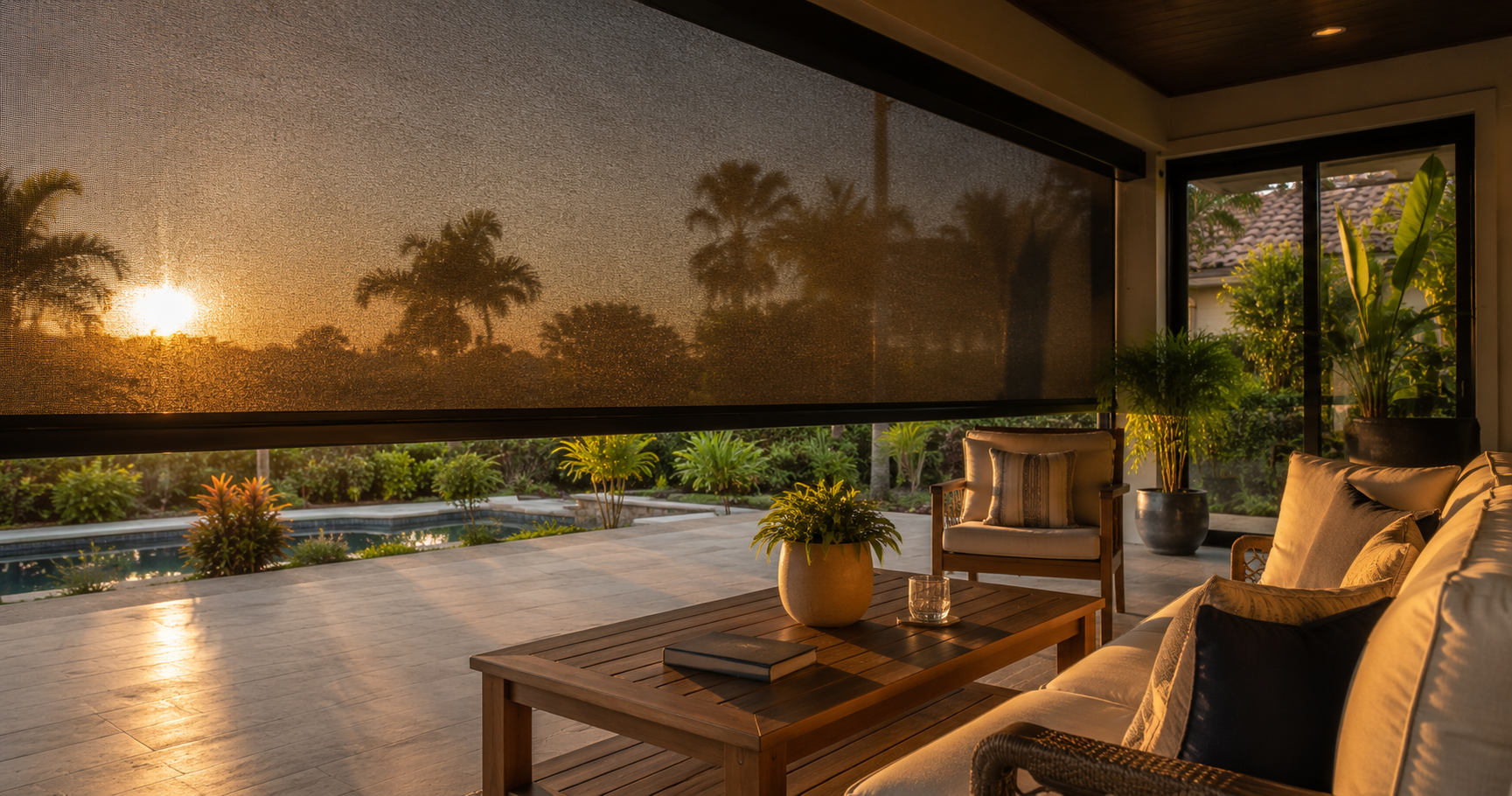
Sun. Hurricane-rated fabric blocks up to 91 percent of the sun's rays while staying transparent enough to see through. That is the specific thing that makes a west-facing lanai usable at five in the afternoon in July. It also reduces heat transfer into the adjoining rooms, which shows up on a cooling bill.
Rain. A roof stops rain falling straight down. Florida rain rarely falls straight down. A deployed screen is what keeps the furniture dry during a normal afternoon storm.
Insects. The tight weave keeps out mosquitoes and no-see-ums. Housings can be fitted with opposing brush seals that keep frogs and crawling insects from working their way around the edge — an unglamorous detail that anyone who has found a tree frog in a screen housing appreciates.
Privacy. During daylight the fabric behaves somewhat like a two-way mirror. You can see out; people on the street have a much harder time seeing in. On a corner lot or a tight subdivision, this is often the feature that sells the screen, and it has nothing to do with weather.
Temperature. Screens do not heat a space, but they cut wind, and cutting wind on a fifty-five-degree evening is most of the difference between sitting outside and going in.
The Deployment Argument
There is a version of storm value that has nothing to do with wind ratings, and it deserves its own section because it is the thing people underestimate.
Consider how the alternatives work when a storm is three days out.
Storm panels have to be carried out of the garage, sorted, lifted, and bolted into tracks around every opening. For an average-sized home this is commonly an all-day job, often done in heat, sometimes on a ladder, frequently by someone who should not be on a ladder. Accordion shutters are far better — most homes close in fifteen to thirty minutes — but they still require walking the perimeter and physically operating each one.
A motorized screen closes in under a minute from a wall switch, a remote, or a phone. And because it is powered, it can be closed by someone who is not there.
That last point matters more than it sounds. Motorized systems integrate with home automation platforms and can be operated from an app, which means a snowbird in Michigan or an owner on a business trip can secure the patio remotely. For second homes and seasonal residents, this is frequently the entire justification, independent of every other benefit on this page.
It also changes behavior in a subtler way. When deployment costs you a full day, you wait to see whether the storm turns. When it costs you a minute, you close the screens on Thursday because the forecast looks unsettled, and open them Friday when it does not. Protection you will actually use beats protection you defer.
When Motorized Screens Are the Wrong Purchase
Four situations. If you are in one of them, we would rather you knew now.
You only need window protection. If your goal is protecting glass on a home with no covered outdoor space you care about, impact-rated windows or accordion shutters do that job at lower cost. Screens earn their premium by protecting open-air space and doubling as everyday climate control. Take away the outdoor room and you have removed most of the value.
You are selling within a few years. This one deserves plain language. Warranty coverage on these systems typically runs to the original owner and does not transfer with the house. A buyer inherits the screens but not the coverage. The screens may still help the sale — they are a visible improvement — but do not count on recovering the investment through warranty value passed along.
There is no power anywhere near the opening. Motorized screens need a circuit at the housing. On new construction this is nothing. On an older lanai with no exterior circuit, an electrician has to run one, and depending on the wall and the panel location that can be a real number. Manual crank versions exist for exactly this case, but a hand-cranked screen used weekly is slow, invites operator error, and has no settable travel limits. Manual is a solution for openings that are rarely cycled, not for the screen you use every day.
You want blackout or security when closed. Screens stay semi-transparent by design. That is the point of them. If you want a genuinely solid barrier — total darkness, a visual and physical deterrent when the house is empty — a roll-down shutter is the honest recommendation, and it costs about the same.
The 365 Way of Thinking About It
Somewhere in the middle of most of these conversations, the frame shifts. The customer stops asking whether the screen is worth it for hurricanes and starts asking what the porch would be like if it worked all year.
That shift is what we mean by MaxForce 365. It is not a product or a feature package. It is a way of evaluating the purchase: judge the screen by how many days of the year it changes what you can do with the space, and let the storm rating be the thing that makes it possible rather than the thing that justifies it.
One screen. Every season. Every storm.
Practically, that framing changes what you should ask about. Storm performance is a laboratory question, answered by test documents. Everyday performance is an operating question — how quietly does it run, how quickly does it deploy, does it still work smoothly in year twelve — and it is answered by how the system is built rather than what it is rated to.
MaxForce screens are approved for use in Miami-Dade County and High Velocity Hurricane Zones under Florida Product Approval FL8637-R15 and rated to 185 MPH. They also use a self-adjusting side track under Quiet Spring Technology, which holds tension automatically so the screen runs consistently as the aluminum expands and contracts through Florida heat cycles. The first sentence is why it qualifies as opening protection. The second is why you will still be using it in a decade.
Three Questions to Ask Yourself
Before you get a quote, answer these honestly. They will settle the question faster than any comparison chart.
How many days last year did weather drive you off that space? If the answer is under twenty, the everyday case is weak and you should probably be looking at cheaper storm-only protection.
Would you use the space more if the weather stopped mattering? Some people want an outdoor room and do not have one. Others simply are not outdoor people, and there is nothing wrong with that.
Are you the person who puts up the panels? If you are sixty-eight and the answer is yes, the deployment argument may matter more than every other line on the quote combined.
Frequently Asked Questions
Are motorized patio screens worth it?
Motorized patio screens are worth it if you use the outdoor space regularly and want protection you can deploy in under a minute without handling panels. They are a weaker fit if you need one-time protection for windows you rarely open. The value case rests on how often the screen runs during ordinary weather — sun, rain, insects, privacy — not on hurricane season alone.
Do patio screens work for anything besides hurricanes?
Yes, and that is where most of their value sits. Hurricane-rated fabric blocks up to 91 percent of the sun's rays while remaining see-through, stops wind-driven rain that a roof alone does not, keeps out mosquitoes and no-see-ums, provides daytime privacy, and cuts wind on cool evenings. For most Florida households the everyday deployments outnumber storm deployments by a hundred to one.
Can motorized screens be closed remotely?
Yes. Motorized screens integrate with home automation systems and can be operated by app, remote, wall switch, or voice assistant. For seasonal residents and second-home owners this is often the deciding factor, since the patio can be secured ahead of a storm by someone who is not in the state.
Does the warranty transfer if I sell the house?
Typically no. Coverage on these systems generally runs to the original owner and is not transferable. A buyer inherits the screens but not the warranty. Worth factoring in if you expect to sell within a few years.
How much do motorized hurricane screens cost?
Motorized hurricane screens generally cost $20 to $60 per square foot installed, putting most single lanai or patio openings between $2,000 and $8,000. Custom systems built to a measured opening run higher. Price moves with opening width, motor and control system, fabric wind rating, and Florida Product Approval status.
How long do motorized hurricane screens last?
A well-built motorized hurricane screen system lasts 10 to 20 years, with components aging at different rates. Hurricane fabric is commonly warranted for 10 years, motors for 5, and structural aluminum is typically covered for life. The component that most often ends a screen's service life is the track, not the fabric.