A Quiet Hurricane Season Is Not a Safe One
The facts, up front
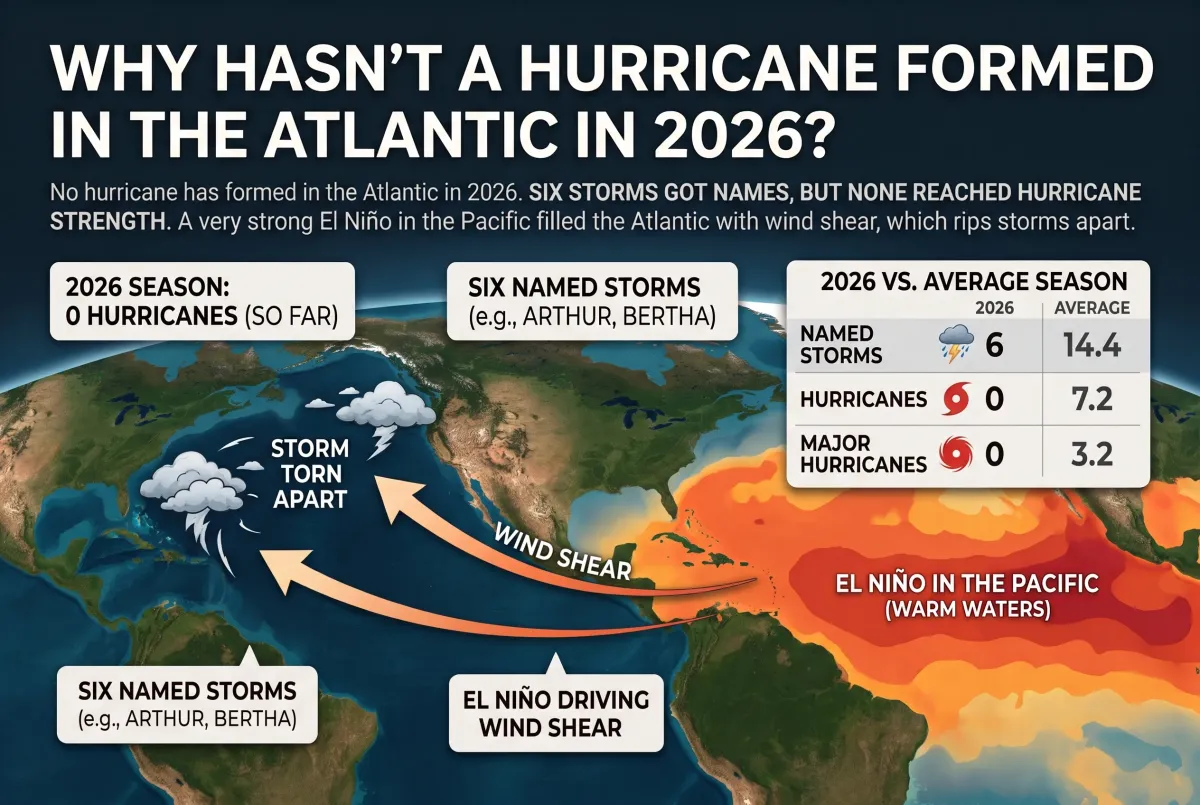
Hurricanes in the Atlantic so far in 2026: zero
Named storms: six — Arthur, Bertha, Cristobal, Dolly, Edouard, Fay
Season energy (ACE): 5.1, under five percent of normal
Last time this happened: 1914
Seasons since 1851 with no hurricane at all: two, 1907 and 1914
Cause: wind shear driven by a very strong El Niño
What it means for your house: lower odds this year, no change to the next twenty
Why hasn't a hurricane formed in the Atlantic in 2026?
Wind shear. The storms keep getting torn apart before they can stand up.
Here's what that means. A hurricane is basically a chimney. Warm wet air rises off the ocean, dumps its heat high up, and that drop in pressure pulls more air in behind it. The whole thing only works if the chimney stays straight.
Now tilt it. When the wind near the water blows one way and the wind five miles up blows another, the chimney leans. The heat that should pile up in the middle gets dragged off sideways. Dry air sneaks in. The storm comes apart.
That difference between the low wind and the high wind is called wind shear, and the Atlantic has been full of it all year.
The cause isn't in the Atlantic at all. It's a very strong El Niño sitting in the Pacific, thousands of miles away.
NOAA's Climate Prediction Center reported on 10 September that water in the eastern equatorial Pacific had passed +3.0 °C above average. Below the surface, some readings were more than +10 °C above normal. That much warm water changes how air moves across the whole hemisphere, and one of the things it does is crank up the wind shear over the Atlantic.
This isn't a new theory. William Gray worked it out in two papers in 1984, and it's the reason anyone can forecast a hurricane season at all.
Is this the strongest El Niño ever recorded?
Not yet, and the measurements are worth looking at, because most coverage is getting this wrong.
The number people usually quote is Niño-3.4. In August it sat at +1.8 °C. Strong — but the threshold for "very strong" is +2.0 °C, so it hasn't cleared that bar.
Pacific sea surface temperature readings, August 2026
Index | Reading | What it means |
|---|---|---|
Niño-3.4 | +1.8 °C | Strong. Below the +2.0 "very strong" line. |
Niño-3 | +2.5 °C | Very strong |
Niño-1+2 | +3.4 °C | Extreme. This is an east-based event. |
Niño-4 | +0.1 °C | Basically normal |
Source: NOAA Climate Prediction Center, ENSO Diagnostic Discussion, 10 September 2026.
The record talk comes from a forecast, not a reading. CPC gives it a 75 percent chance of setting a record over October through December. It might. It hasn't yet.
One more thing in that table matters. Niño-1+2 is way out ahead of Niño-3.4, which tells you the warm water is stacked toward the eastern end of the Pacific. East-based events don't behave quite like the ones centered further west. Small detail, but it's the difference between reading the data and reading the headline.
Is the Atlantic Ocean unusually warm this year?
No. And this is where the popular version of the story falls apart.
The easy line is that the ocean is loaded with fuel and only the sky is holding it back. It sounds good. It isn't true this year.
The Main Development Region is the strip of tropical Atlantic between the eastern Caribbean and Africa where the big long-track hurricanes get born. It's been running about +0.17 °C above average. In 2023 and 2024 it was closer to +1.2 °C. The American Meteorological Society called the region average or a touch below back in June.
So the Atlantic is sitting right about where it usually sits.
That is not the comfort it sounds like. A normal Atlantic makes 7.2 hurricanes in an average year. Normal is not the same thing as harmless. The water is doing its usual job. It's the air above it that changed.
Is a quiet hurricane season actually safer?
Yes. It is. And you should be suspicious of anyone in my industry who tells you otherwise.
The research on this goes back forty years and it's not close.
Gray looked at every major hurricane that hit the United States between 1900 and 1983. Fifty-four of them. Only four landed during the sixteen El Niño years in that stretch. That works out to one major hurricane every four years under El Niño, against roughly three every four years the rest of the time.
Bove and four colleagues published a follow-up in the Bulletin of the American Meteorological Society in 1998 with the numbers most people quote today.
Same study, on the odds of getting hit more than once in a year: 28 percent under El Niño, 48 percent in neutral years, 66 percent under La Niña.
Pielke and Landsea went after the money instead of the count. Typical storm damage, adjusted for inflation and development, came to about $150 million in El Niño years. In La Niña years it was $3.3 billion.
That is a twenty-two-fold gap. It is real and I'm not going to pretend it isn't.
So what's the catch?
Read what those numbers count.
Every single one of them is counting how many. How many storms formed. How many reached land. How much damage they added up to across a whole season.
Not one of them says a hurricane that forms during El Niño is a weaker hurricane.
There's no study that says that, because that's not how any of this works. Shear stops storms from getting organized in the first place. It doesn't put a lid on the ones that manage it anyway.
Fewer storms. Same ceiling.
Has a quiet season ever produced a major hurricane?
Yes. More than once, and the examples are not obscure.
1992. Seven storms all year — six named, plus an unnamed subtropical storm in April. Four hurricanes. Colorado State had called it back in December 1991: eight named storms, four hurricanes, one major. They never revised it. On hurricanes and majors they nailed it.
On 16 August 1992, the National Hurricane Center spent time with reporters talking about the hurricane season that hadn't shown up.
That same day, a wave coming off Africa tightened into a tropical depression.
It got the name Andrew the next morning. On the 20th it nearly died under wind shear. On the 22nd it found clean air and became a hurricane. On the 24th it came ashore near Homestead at 922 millibars.
It wrecked or destroyed more than 125,000 homes. Roughly a quarter of a million people had nowhere to sleep. The bill was $27.3 billion in 1992 money, closer to $60 billion now.
The forecast was right. The season was quiet. Neither one did a thing for anybody in south Miami-Dade.
1983. Four named storms the whole year, shut down by El Niño shear. One of them was Alicia, and Alicia went into Houston and Galveston as a Category 3.
1905. Five storms. Exactly one hurricane — the fewest since 1890. That one hurricane went from Category 1 to Category 3 in about a day and topped out at 120 mph. It stayed offshore, so nobody on the US coast felt it, but the storm itself didn't know that was the plan.
What happened after the last hurricane-free seasons?
Both times, the following year was busy. Both times.
Only two seasons since records began in 1851 have gone all the way through without a hurricane. Here's what each one did, and what came next.
Hurricane-free Atlantic seasons and what followed
Season | Storms | Hurricanes | Majors | ACE |
|---|---|---|---|---|
1907 | 5 | 0 | 0 | 13.06 |
1908 | 10 | 6 | 1 | 95.11 |
1914 | 1 | 0 | 0 | 2.53 |
1915 | 6 | 5 | 3 | 130.10 |
2026 | 6 | 0 | 0 | 5.1 |
Source: NOAA HURDAT2. 2026 figures are season to date.
1915 is the one people remember. Four hurricanes hit the United States that year and more than 700 people died. Two of them came in at Category 4 — one into Galveston in August, one into Louisiana in September.
Now here's the part I have to say out loud, because it's the first thing a sharp reader will think.
Two cases is not a pattern. And a season with zero hurricanes is sitting on the floor. Whatever comes next is almost guaranteed to be higher, because it can't be lower. That's arithmetic, not weather.
What I'd point to instead is how far they came back. Neither year crawled up to slightly-above-nothing. 1908 hit 95 and 1915 hit 130, against a long-run average somewhere around 100. Both went straight back to normal or past it.
One more caveat, and it cuts against my own argument. Nobody had satellites in 1907. Hurricanes that stayed away from land and shipping lanes simply weren't seen. The 1907 record itself flags four other systems that might have been storms. Those "zero hurricane" seasons may partly be a record of who was looking.
Should you wait for an active season before protecting your home?
No, and here's the part that actually matters.
Most talk about hurricane risk uses the season as the unit. This year looks bad. That year looks fine. For deciding whether to cover an opening on your house, that's the wrong unit completely.
El Niño and La Niña swap places every two to seven years. A screen or shutter you put on your house is there for fifteen, twenty, twenty-five. Something installed this fall is still on that opening through the next several flips of the Pacific.
You're not buying protection for this season. You're buying it for the next twenty seasons. What the Pacific happens to be doing in the year you install has almost nothing to do with what the thing is worth.
Two more findings worth knowing, because they rarely make the news.
Smith and colleagues found in 2007 that La Niña really does drive up landfalls on the East Coast — but for Florida and the Gulf specifically, they found little difference from a normal year. The ENSO signal that jumps out of the basin-wide totals gets much fainter on the stretch of coast most Floridians live on.
And Klotzbach and Gray, working with the relationship Gray discovered himself, pointed out that the El Niño link hasn't held up as well since 1995. The people who know these statistics best are the most careful about what they'll claim.
The quiet this year is real. It's explainable, it's measurable, and it will end. The right response isn't panic and it isn't relief. It's noticing that the number of storms in a season was never the number your decision was resting on.
Common questions
Has any hurricane formed in the Atlantic in 2026?
No. As of late September 2026, six storms have been named and none reached hurricane strength. The previous record for the latest first hurricane in the satellite era was 11 September, set in 2002 and tied in 2013. This season passed it.
What is causing the quiet 2026 hurricane season?
Wind shear from a very strong El Niño in the Pacific. Shear tilts a developing storm so the heat that should build in its core gets pulled away sideways, and the storm falls apart before it organizes.
Does El Niño make hurricanes weaker?
No. El Niño reduces how many storms form and how many reach land. No research shows it limits the strength of the ones that do form.
Has a quiet hurricane season ever caused major damage?
Yes. 1992 had only seven storms and four hurricanes. One of them was Andrew, which hit south Florida at 922 millibars and caused $27.3 billion in damage in 1992 dollars. 1983 had four named storms, and one was Alicia, a Category 3 into Houston and Galveston.
Is 2026 the strongest El Niño on record?
Not yet. The Niño-3.4 index was +1.8 °C in August, below the +2.0 °C mark for a "very strong" event. NOAA gives it a 75 percent chance of setting a record over October through December, but that is a forecast rather than a measurement.
Will 2027 be a bad hurricane season?
Nobody knows, and be careful with anyone who says they do. Both previous hurricane-free seasons were followed by active ones, but that is two cases, and a season at zero has nowhere to go but up. What can be said is that El Niño is temporary and the Atlantic stays capable of producing hurricanes in any year.
Where MaxForce™ fits
MaxForce™ Hurricane Track by Fenetex® is tested and certified for the 185mph wind zone, meeting or exceeding all local and International Building Codes, including the High Velocity Hurricane Zone (HVHZ) of Miami-Dade and Broward Counties. It is approved for use in Miami-Dade County and the HVHZ under Florida Product Approval FL8637-R15.
None of that was written against this year's forecast. Codes are written against a design event, not a season. It's the same reason a quiet year doesn't change what a permit asks for.
Next in this series: how the code covering openings in South Florida came to exist, and the storm in a quiet season that wrote it.
Weather data from NOAA's National Hurricane Center and Climate Prediction Center, plus peer-reviewed research in Monthly Weather Review and the Bulletin of the American Meteorological Society. Imagery courtesy of NOAA. MaxForce™ is a product of Fenetex® Corporation.
