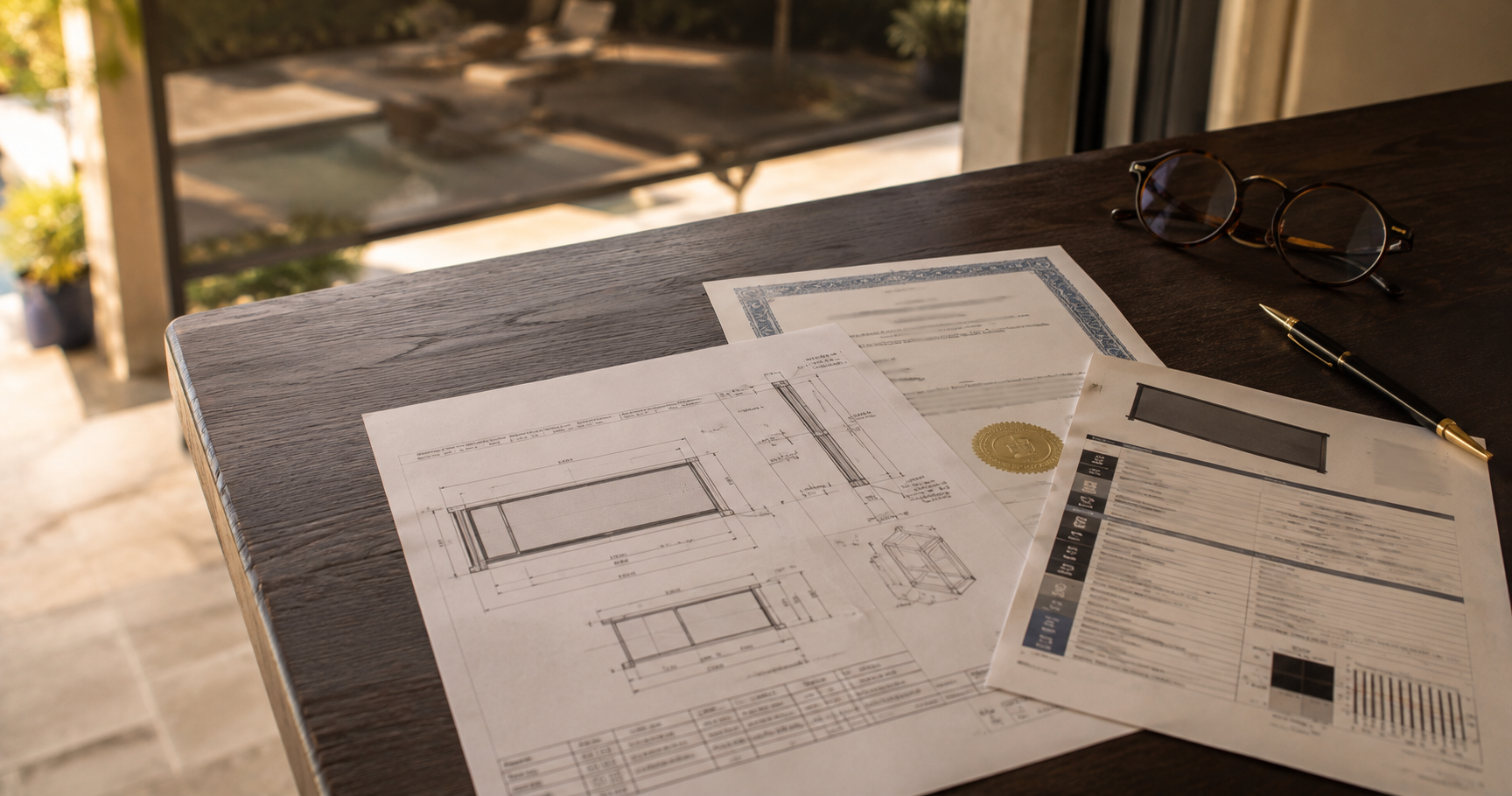
What Is the Best Hurricane Screen? How to Judge One Without the Marketing
Search this question and you will get a list of companies, each of which is described as the best. That is not an answer. That is an index.
The trouble is structural. "Best hurricane screen" has no meaning without a home attached to it. A screen that is ideal for a twenty-four-foot lanai in Naples is the wrong product for three second-floor windows in Ocala, and both of those are different from a restaurant patio in Key West that gets deployed forty times a year.
What does have meaning is a set of criteria you can hold every quote against. There are four of them. They are not opinions, they are documents, and any manufacturer can produce them or cannot.
This is that checklist.
First: The Approval Number, in Writing
Every hurricane protection product legally installed in Florida carries a Florida Product Approval number, or in some cases a Miami-Dade Notice of Acceptance. These are not the same instrument, and the distinction matters more than most salespeople acknowledge.
A Florida Product Approval is a statewide approval, issued after the product passes required testing, with stamped engineering behind it. It carries a revision number that increments as the product changes. A Notice of Acceptance is issued by Miami-Dade County specifically. A product can carry a Florida Product Approval that permits use in High Velocity Hurricane Zones, including Miami-Dade County, without holding a separate NOA.
What you want is the number, including the revision suffix. Not "we're Miami-Dade certified." Not "fully approved." The number.
Then check the revision. Approval documents get superseded, and it is common to find a company citing a revision two versions behind what is current — sometimes because their own website still hosts the old PDF. If the number they give you does not match what is current in the state database, ask why.
There is a second question hiding inside this one, and it is the one almost nobody asks: does the approval cover my opening?
Approvals specify maximum dimensions and permitted anchoring conditions. A manufacturer can build a screen outside that scope — most will, if you ask — but doing so puts the installation outside the approved configuration, and responsibility for confirming the use is allowable under local code shifts to the purchaser and the installer. That may be perfectly fine for your situation. It should be a decision, not a surprise.
Second: Design Pressure for Your Configuration
Wind speed gets all the marketing attention. Design pressure does the actual engineering work.
Wind speed is a rating for the system — 185 MPH, for instance. Design pressure is the load, measured in pounds per square foot, that a particular assembly is rated to carry, positive and negative. And here is the part that surprises people: it is not one number for the product. It varies by assembly, by size, and by how the tracks are anchored.
Florida engineering documentation handles this precisely. The site-specific pressure requirement for your home, calculated under the current ASCE 7 standard, has to be less than or equal to the listed design pressure capacity for the assembly you are installing. Those listed capacities already incorporate a safety factor.
So the useful question is not "what's your design pressure." It is: what is the design pressure for a screen this size, anchored this way, on my structure — and does it exceed what my location requires?
A dealer who can answer that has read the approval. A dealer who quotes you a single headline number for every opening has not.
Third: What the Fabric Was Actually Tested Against
Hurricane-rated fabric has almost nothing in common with window screen, and the testing is where you can see it.
Florida's High Velocity Hurricane Zone requires products to pass three protocols. TAS 201 is large missile impact. TAS 202 is uniform static air pressure. TAS 203 is cyclic wind pressure loading. The equivalent international standards are ASTM E1886, E1996, and E330.
The large missile test is the one worth picturing. A nine-pound two-by-four is fired at the assembly at roughly fifty feet per second, and then the assembly is put through thousands of cycles of alternating positive and negative pressure to simulate a storm's duration. Rigid systems and fabric systems both have to survive it. They just do it differently — a rigid shutter resists the impact, while a tensioned fabric absorbs and distributes the energy, which is part of why fabric performs well on large and irregular openings.
Ask which protocols the screen was tested to and ask for the fabric by name. "Hurricane-rated mesh" is not a specification. MaxForce screens use Twitchell OmegaTex, built with the same aramid fibers used in ballistic vests, which blocks up to 91 percent of the sun's rays while remaining transparent enough to see through from inside.
That last property is not a small thing. Solid shutters black out a room completely. Being able to see what is happening outside during a storm — and having daylight during a multi-day power outage — is a genuine difference in how the two feel to live behind.
Fourth: The Track, Which Nobody Asks About
The first three criteria are about surviving a storm. The fourth is about the other 8,750 hours of the year.
A screen has to be gripped tightly enough at its edges that extreme wind cannot pull it from the channel, and loosely enough that a motor can cycle it thousands of times without binding. Aluminum, which forms the track, expands and contracts through every Florida heat cycle — and it does that daily, for two decades, while the building itself settles and columns drift fractionally out of plumb.
A track built to a fixed dimension is set once, for one condition. Over years, the running clearance drifts. The screen starts to chatter, or stops halfway, or seats slightly crooked. The homeowner uses it less because using it has become a hassle.
A hurricane screen that nobody deploys is not protecting anything, regardless of what it is rated to withstand.
So the two questions are: is the side track fixed or self-adjusting, and how is the screen edge retained? Zippers are common and they are the most frequent warranty complaint in the category — they have teeth, teeth strip, and a failure in one spot opens the whole edge. Sewn edges wear. A welded edge cannot come apart.
What "Best" Means, Depending on Who Is Asking
Once the four criteria are satisfied, the remaining choice is about fit. Here is roughly how it breaks down.
Mixing types across a single home is normal and often smart. Panels on the utility-room window, screens across the lanai, impact glass on the front elevation. Nothing requires one solution everywhere.
Language That Should Slow You Down
This industry has a superlative problem, and it is worth naming plainly because it is the fastest way to sort serious companies from loud ones.
Phrases like "the only," "the strongest available," "outperforms all competitors," and "the world's toughest" are extremely common in hurricane protection marketing. They are also, almost without exception, unverifiable. Several manufacturers hold Florida Product Approvals for High Velocity Hurricane Zones. Any claim that one company alone meets a public building code standard is checkable and usually wrong.
None of this means a company making those claims builds a bad product. It means the claim is not evidence. Replace it with a document.
Three more worth watching for. A wind rating quoted without an approval number attached. Warranty described as "lifetime" without a component breakdown, since no screen has one lifetime — the aluminum and the motor are not on the same schedule. And a quote that never mentions permits or electrical, which are separate costs on nearly every job.
How MaxForce Answers the Four
It would be inconsistent to spend an article arguing against superlatives and then use one. So, plainly:
Approval. Florida Product Approval FL8637-R15, approved for use in Miami-Dade County and in High Velocity Hurricane Zones. Rated to 185 MPH.
Design pressure. Rated per assembly configuration under FL8637-R15 [DESIGN PRESSURE]. Your dealer can provide the value that covers your specific opening size and anchoring condition — and that is the number that matters, not a headline figure.
Fabric. Twitchell OmegaTex, aramid-reinforced, tested under TAS 201, 202, and 203 and the ASTM E1886, E1996, and E330 protocols. Blocks up to 91 percent of the sun's rays and remains see-through from inside.
Track and edge. Self-adjusting side track under Quiet Spring Technology, providing nearly an inch of automatic tension travel, covered by U.S. Patents 9,458,666 and 12,018,527. The screen edge is a keder cord fused to the fabric by radio-frequency welding — no zipper, no stitching, no adhesive.
Whether that adds up to the best screen for your home depends on your home. But every one of those statements is a document you can ask to see.
Frequently Asked Questions
What is the best hurricane screen?
There is no single best hurricane screen, because the right system depends on your wind zone, opening size, and how often you plan to use it. The screens worth considering all carry current Florida Product Approval, a documented design pressure rating for your opening size, a fabric tested to your county's wind requirement, and a track that still runs smoothly after years of thermal cycling.
Is Florida Product Approval the same as Miami-Dade certification?
No. A Florida Product Approval is a statewide approval issued after required testing, with stamped engineering behind it and a revision number that increments as the product changes. A Miami-Dade Notice of Acceptance is issued separately by that county. A product can hold a Florida Product Approval permitting use in High Velocity Hurricane Zones, including Miami-Dade County, without holding a separate NOA.
What tests do hurricane screens have to pass?
For Florida's High Velocity Hurricane Zone, products must pass TAS 201 large missile impact, TAS 202 uniform static air pressure, and TAS 203 cyclic wind pressure loading, along with the ASTM E1886, E1996, and E330 equivalents. The large missile test fires a nine-pound two-by-four at roughly fifty feet per second, followed by thousands of alternating pressure cycles.
How much do motorized hurricane screens cost?
Motorized hurricane screens generally cost $20 to $60 per square foot installed, putting most single lanai or patio openings between $2,000 and $8,000. Custom systems built to a measured opening run higher. Price moves with opening width, motor and control system, fabric wind rating, and Florida Product Approval status.
Are motorized patio screens worth it?
Motorized patio screens are worth it if you use the outdoor space regularly and want protection you can deploy in under a minute without handling panels. They are a weaker fit if you need one-time protection for windows you rarely open. The value case rests on how often the screen runs during ordinary weather, not on hurricane season alone.
How long do motorized hurricane screens last?
A well-built motorized hurricane screen system lasts 10 to 20 years, with components aging at different rates. Hurricane fabric is commonly warranted for 10 years, motors for 5, and structural aluminum is typically covered for life. The component that most often ends a screen's service life is the track, not the fabric.