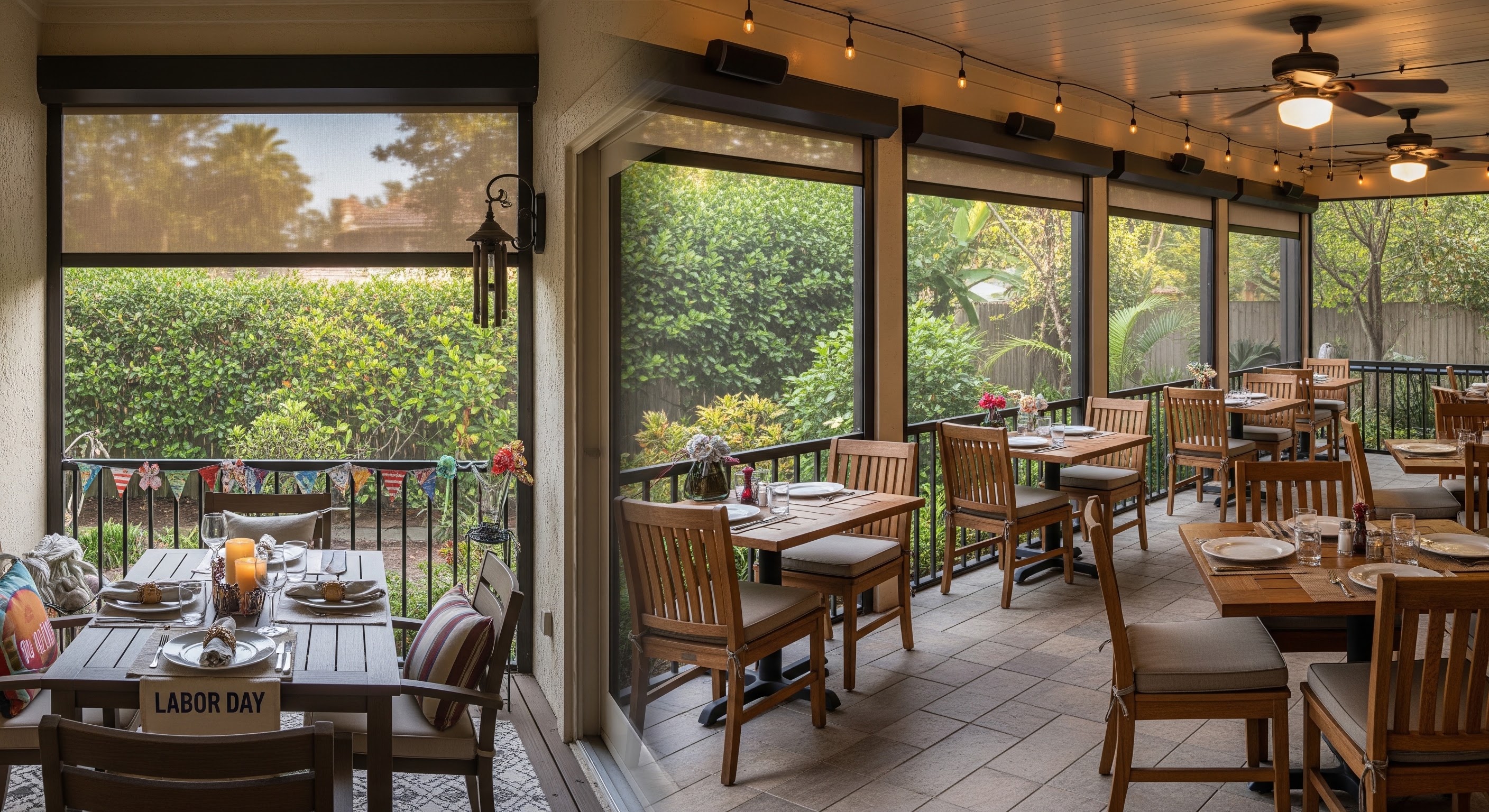
Hosting at Home vs. Hosting at the Restaurant: What Changes for Storm-Rated Screening on Labor Day
Hosting at Home vs. Hosting at the Restaurant: What Changes for Storm-Rated Screening on Labor Day
The last post in this series named three things more likely to disrupt a Florida Labor Day gathering than a hurricane itself: direct sun, peak-season mosquitoes, and how close the holiday sits to the year's statistical storm peak. Once a homeowner or a restaurant owner accepts that any of that is worth addressing, the next question is what actually changes about a storm-rated screen system depending on which one they're protecting. The two share the same underlying certification. Almost nothing else about the installation looks the same.
What actually changes for a home lanai
A home lanai is usually the simpler installation: one opening, sometimes two, each up to 25 feet, sized to the exact dimensions of the space. Control is typically a handheld remote or a phone, and most residential installs are completed in one to two days once final measurements are taken — the total timeline depends mainly on production lead time, since each screen is built to order rather than off a shelf.
What actually changes for a restaurant or commercial patio
A restaurant or event patio more often means multiple openings, and larger or multiple openings are handled with independently operating screens rather than one continuous barrier. That independence matters operationally — a restaurant can screen part of a patio while leaving another section open, something a single home opening doesn't need to think about. Commercial and hospitality use is also a segment the wider hurricane-protection category has flagged as a rising area of growth in its own right, not an afterthought to residential demand.
Control tends to move up a level too. With multiple zones to manage, smart home integration stops being a convenience feature and becomes the practical way to schedule and coordinate several screens at once, rather than operating each one by hand. And because a restaurant patio is guest-facing, matching the frame and fabric to an existing color scheme through the available finish options tends to matter more than it does for a private home. The one step a home project doesn't have: an enclosed, guest-occupied commercial space typically triggers a local occupancy and egress review as part of permitting, which a certified dealer coordinates alongside the local building department.
What stays exactly the same
The certification basis doesn't change. Whether the opening is a home lanai or a restaurant patio, the underlying system is the same HVHZ design, approved under Florida Product Approval FL8637-R15 — the differences described above are scale and coordination, not a different or lesser-rated product for one use case versus the other.
So which matters more for Labor Day specifically?
For a home hosting a holiday cookout, the practical question is whether there's enough lead time left before the 24th to get measured, given screens are built to order rather than stocked. For a restaurant planning to keep a patio open through the holiday weekend, the more useful move is starting the occupancy conversation with a certified dealer now, since that review tends to be the longer pole in a commercial timeline, not the screen itself.
The next piece in this series is shorter and more practical: a weekend-before checklist for whatever's already installed, published September 3.
Frequently Asked Questions
Does a restaurant patio need a different certification than a home lanai?
No. Both use the same HVHZ certification basis under Florida Product Approval FL8637-R15. What differs is scale, control setup, and the permitting process — not the underlying rating of the system.
Can one system cover a large commercial patio, or does it need multiple screens?
Larger or multiple openings are handled with independently operating screens rather than one continuous piece, which lets sections of a patio be screened separately from the rest.
Does smart home integration work for a business with multiple zones, not just one house?
The manufacturer states compatibility with commercial-grade automation platforms including Control4, Crestron, and Savant, alongside standard voice assistants — built for coordinating multiple zones, not just a single-home setup. That's the manufacturer's stated compatibility, not an independently verified performance benchmark.
Sources
MaxForce Hurricane Screens. Product specifications, installation, and compatibility claims, self-reported by the maxforcescreens.com.