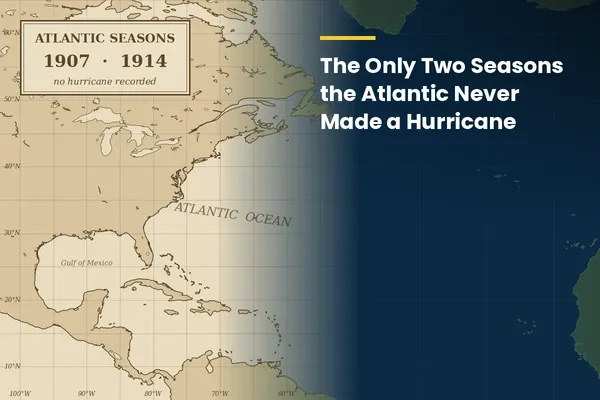
The Only Two Seasons the Atlantic Never Made a Hurricane
The facts, up front
Seasons with no hurricane since 1851: two — 1907 and 1914
1914 storms: one, formed on September 14. Least active season on record
1908, the year after 1907: ten storms, six hurricanes
1915, the year after 1914: six storms, five hurricanes, three majors, four US landfalls
1905: five storms, one hurricane — and that hurricane reached Category 3
2026’s first hurricane: October 8, tying 1905 for the latest on record
2026’s season energy as of October 22: about 19.5, now above both 1907 and 1914
What you can conclude about 2027: nothing
Has the Atlantic ever gone a whole season without a hurricane?
Twice. 1907 and 1914. That's it, in a record run back to 1851.
1907 produced five tropical storms. Three of them came ashore on the Gulf Coast. Damage was minor, and nobody died.
1914 was stranger. One storm. The entire season. It didn’t form until September 14, which is the latest any Atlantic season has ever started since record-keeping began.
Season energy came in at 2.53. It remains the least active Atlantic season ever recorded.
What happened in 1905?
Five storms formed and exactly one became a hurricane — the fewest in a season since 1890. That one hurricane reached Category 3.
This is the season worth paying attention to, more than 1907 or 1914, because something actually happened in it.
The storm started as a depression in the southwestern Caribbean on October 1. It reached tropical storm strength on the 3rd, slid through the Windward Passage on the 5th and 6th, brushed eastern Cuba without doing much, then went out into the open Atlantic.
Somewhere between Bermuda and Turks and Caicos, it became a hurricane. Later on October 8, it was a Category 2. Early on October 9, it was a Category 3, topping out at 120 mph.
Season energy for 1905 was 28 — the lowest since 1864.
Two things about this one that matter, and the second cuts against the easy version of the story.
First: a season can be historically quiet and still produce a major hurricane. 1905 is that, in the cleanest form available.
Second: it never hit the United States. It tracked past the Greater Antilles, the Bahamas, Turks and Caicos, and Bermuda without doing real damage on land. Its six deaths came from a rogue wave that swept across the steerage deck of the steamer Campania, well out at sea.
So 1905 shows you that the one storm that forms in a dead season can be a major hurricane. It doesn't show you that it hits anything. Anyone telling you a quiet year guarantees a disaster is going past what the record supports.
What happened after 1907 and 1914?
Both following years were busy. Here's the whole picture.
Hurricane-free Atlantic seasons and the years that followed
1908 is a genuinely odd year. Ten storms, six hurricanes. It's the only Atlantic season on record with two hurricanes before June, and it holds the only March tropical cyclone the basin has ever recorded. The strongest storm reached Category 3 in mid-September and killed at least 26 people in Turks and Caicos and the Bahamas.
1915 is the one people remember. Six storms, five of them hurricanes, three major. Four came ashore in the United States, and more than 700 people died.
Two of those were Category 4. One hit Galveston on August 17 — a city that had already rebuilt behind a seawall after the 1900 disaster, and this storm tested it. The other came into Louisiana near Grand Isle on September 29 at 931 millibars.
A study that adjusted historical damage for modern population and development put the 1915 Galveston storm at $68 billion if it hit in 2005.
So does a quiet year predict an active one?
No. And there are three separate reasons to be careful here, all of which argue against the tidy version.
Two cases are not a pattern. Everyone knows this, and it still gets ignored. You can't build a rule out of 1907 and 1914.
A season at zero is on the floor. Whatever comes next is almost certain to be higher, because it physically can't be lower. That's arithmetic dressed up as insight. If you flipped the calendar randomly, you'd get the same result.
The old data is thin. Nobody had satellites in 1907. A hurricane that spun up mid-ocean, stayed away from land, and missed the shipping lanes was simply never recorded. The 1907 file itself notes four other systems that may have been storms and couldn’t be confirmed. Bryan Norcross at FOX Weather made the same point about both years in September. Those “zero hurricane” seasons may be partly a record of who was looking.
So what can you actually say?
Only this: neither follow-up year crept up to slightly above nothing. 1908 hit 95, and 1915 hit 130, against a normal near 100. Both returned to normal or above. The Atlantic didn’t stay quiet.
That's a smaller claim than "a bad year is coming." It's also one that holds up.
Were 1907 and 1914 quiet because of El Niño, like 2026?
Nobody can say, and the honest answer is more interesting than a yes.
We have good Pacific measurements going back to about 1950. Before that, scientists reconstruct El Niño from indirect evidence — ship logs, rainfall records in Peru, tree rings, coral. Different reconstructions come to different conclusions.
Look at what happens when you check the same three years against three respected sources.
How three reconstructions classify the same years
Three sources. Three different answers for the same years, sometimes the exact opposite of each other.
That's not sloppiness. It's what happens when you try to measure an ocean nobody was measuring then.
Which means we can’t tell you 1907 and 1914 were quiet for the same reason 2026 was quiet through September. It’s a reasonable guess, and it might be right. The record can't support it, and we’re not going to say it as though it did.
How does 2026 compare?
It came closer to joining that list than any season in more than a century, and then it didn’t.
Through September, the Atlantic produced eight named storms and no hurricanes. Fay came within a few miles per hour of the line before wind shear tore it apart. No season had gone that deep without a hurricane since 1914.
Then Isaias formed in the Bay of Campeche on October 6. It became a hurricane on October 8, tying 1905 for the latest first hurricane on record. On October 9, it reached Category 3, with 120 mph winds. On October 10, it came ashore near Destin, Florida.
Read that against the 1905 section above. Same date for the first hurricane. Same peak, Category 3 at 120 mph. One difference: 1905’s storm stayed out at sea. This one didn’t.
Season energy now sits around 19.5, above both 1907 and 1914. The season runs to November 30.
What should you take from this?
Less than the headlines want you to.
You can't read 2027 off 2026. The sample is two, the floor effect is real, and the old records have holes in them.
What the record does support is narrower, and more useful:
Quiet seasons end. Both times the Atlantic went a year without a hurricane, it didn't stay that way— it returned to normal within twelve months. El Niño is weather, not a permanent condition, and it lets go.
And a quiet season can still produce a serious hurricane while it’s running. 1905 had exactly one, and it went to Category 3 in about a day. 2026 had none for four months, then produced one that reached Category 3 and made landfall in Florida.
Neither of those is a forecast. They're just the shape of the thing, and the shape is what matters when you're making a decision that outlasts the season.
Common questions
How many Atlantic seasons have had no hurricanes?
Two since records began in 1851: 1907 and 1914. 1907 produced five tropical storms, and 1914 produced one, which formed on September 14 — the latest start to any season on record.
What happened the year after each hurricane-free season?
Both following years were active. 1908 produced ten storms and six hurricanes. 1915 produced six storms, five hurricanes, and three majors, with four US landfalls and more than 700 deaths.
Does a quiet hurricane season mean the next one will be bad?
No. There are only two cases: a season at zero can only go up, and pre-satellite records are incomplete. What the record supports is narrower: both times the Atlantic went hurricane-free, it returned to normal activity the following year.
Can a quiet season still produce a major hurricane?
Yes. 1905 produced five storms, and only one hurricane, the fewest since 1890, and that hurricane reached Category 3 with 120 mph winds. It stayed offshore. In 2026, Isaias became the season’s first hurricane on October 8, the same date as 1905’s. It also reached Category 3 at 120 mph, and it made landfall near Destin, Florida.
Were the hurricane-free seasons caused by El Niño?
Unknown. Reliable Pacific measurements only go back to about 1950. Reconstructions of earlier years disagree — NOAA's extended index classifies 1907 and 1914 as La Niña, while other published reconstructions classify 1914 as El Niño.
How does 2026 compare to 1907 and 1914?
2026 went longer without a hurricane than any season since 1914, then produced one. Isaias became a hurricane on October 8, tying 1905 for the latest first hurricane on record, and reached Category 3 before landfall in Florida. The season’s energy, about 19.5 as of October 22, is now above both 1907 and 1914.
How reliable are hurricane records from the early 1900s?
Incomplete, and acknowledged as such. Without satellites, storms that stayed away from land and shipping lanes went unrecorded. The 1907 record notes four additional systems that may have been storms but could not be confirmed.
Did the 2026 Atlantic season have a hurricane?
Yes. After no hurricanes through September, Isaias became the season’s first hurricane on October 8 and reached Category 3. It made landfall near Destin, Florida, on October 10.
Where MaxForce™ fits
MaxForce™ hurricane screens are engineered for use in High Velocity Hurricane Zones and approved for Miami-Dade County under Florida Product Approval FL8637-R15, rated for the 185 MPH wind zone.
Nothing on this page tells you what next year looks like. That's rather the point. A system fitted to an opening is there for fifteen or twenty years, which covers a lot of seasons — quiet ones, busy ones, and the ones nobody saw coming.
Next in this series: what forty years of research actually says about El Niño and hurricanes, including the parts that argue against us.
Season data from NOAA’s HURDAT2 Atlantic hurricane database and the Partagás and Díaz historical reanalysis. 2026 season data from National Hurricane Center advisories. ENSO reconstructions from NOAA’s Physical Sciences Laboratory and published research in the Journal of Climate. MaxForce™ is a product of Fenetex® Corporation.