The Building Code Hurricane Andrew Wrote
The facts, up front
Separate building codes in Florida before 1992: more than 400
Shutters required over glazing before Andrew: none
Florida homes Andrew damaged or destroyed: more than 125,000
First post-Andrew code: 1994
Florida Building Commission created: 1998
Statewide Florida Building Code took effect: 1 March 2002
Counties in the High Velocity Hurricane Zone: two of 67 — Miami-Dade and Broward
What the HVHZ covers that nowhere else does: the whole building envelope, not only glazed openings
What did South Florida's building code require before Hurricane Andrew?
Over your windows? Nothing.
That surprises people, so it's worth being precise. The South Florida Building Code had exactly one provision touching hurricane protection, and it was conditional. If you chose to put shutters up, they weren't allowed to flex so far that they broke the glass behind them.
That was it. No requirement to have them. Just a rule about how they had to behave if you did.
The code that governed the most hurricane-exposed metro area in the United States treated covering your openings as optional.
How many building codes did Florida have before Andrew?
More than 400.
Not 400 pages. Four hundred separate codes, written and enforced locally. What was required on one side of a county line might not be required on the other.
Enforcement was the other half of the problem. Richard Olson, who directs the International Hurricane Research Center at Florida International University, told ABC News that cutting corners was routine across the state then.
What did Andrew actually break?
Roofs, mostly. And then everything under them.
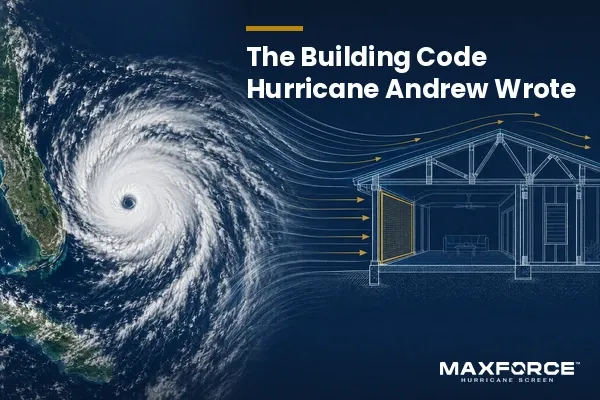
The failure pattern was consistent. Wind gets inside the building. Once it's inside, it pushes out on the walls and up on the roof, while the wind outside pulls. The house comes apart from the inside.
Wind usually gets in through an opening. A window goes, or a door, or a garage door, and the building stops being a sealed box.
Looking back, state officials described the destruction as a combination of things: the winds themselves, an outdated code, construction that cut corners, and inspections that didn't catch it.
Three of those four are fixable with paper. That's what the next ten years were about.
When did Florida's building code change?
In stages, over a decade. It was slower and more contested than most people assume.
1994. South Florida rewrote its own code first. This is the one that matters if you're looking at a house — homes built from 1994 onward were built to a meaningfully different standard than what came before.
1998. The recommendations became state law, and the Florida Building Commission was created. The fight over whether Florida should have a statewide code was long and contentious. Builders pushed back on the impact requirements for years.
2001. The first Florida Building Code was published, carrying the impact provisions.
1 March 2002. It took effect. Four hundred codes became one.
South Florida had a condition. They had already written the strictest rules in the country, and they weren't giving them up to join a statewide average. So they carved out their provisions and kept them as a separate tier inside the new code.
That tier is the High Velocity Hurricane Zone.
What is the High Velocity Hurricane Zone?
Two counties. Miami-Dade and Broward, out of Florida's 67.
It isn't a coastal zone or a wind-speed line drawn on a map. It's a jurisdiction — the two counties that took the worst of Andrew and responded by writing rules nobody else was willing to write.
If your house is in those two counties, the code asks for more than it asks anywhere else in America.
Why does South Florida regulate the whole building, not just the windows?
Because Andrew didn't only come in through windows.
This is the part worth understanding, and it's the single thing that makes the HVHZ different from every other windborne debris region in the country.
Everywhere else, the rules are about glazing. Protect the glass — with impact-rated glass or with something over it — and you've met the requirement.
The HVHZ doesn't stop at the glass. As STRUCTURE magazine puts it, the HVHZ remains the only region that requires impact resistance across the entire building envelope, not just glazed openings.
The envelope is the whole outside surface. Walls, roof, doors, glass — and openings that never had glass in them to begin with.
That last category is the one people miss. A screened porch. A lanai. A covered outdoor room with a wide opening and no windows anywhere.
Physics doesn't care that there's no glass there. An opening is an opening. If wind and debris get through it into the structure, the same pressure builds up inside and does the same thing to the roof.
South Florida figured that out in 1992 by watching it happen, and wrote a code that treats the opening as the thing to protect instead of the pane. Whether a particular porch or lanai opening has to meet that requirement depends on how it’s built and how it connects to the house, which is a question for the building department.
Did the new code actually work?
Yes, and there's field evidence rather than just theory.
In 2004, four hurricanes crossed Florida. Researchers at the University of Florida went out afterward and surveyed 200 randomly selected homes in the highest wind zones.
They sorted them by build date.
Damage by construction era, 2004 Florida hurricanes
Built | Code in force | How it held up |
|---|---|---|
Before 1994 | Pre-Andrew codes | Worst performance of the three groups |
1994–2001 | Standard Building Code | Better than pre-1994 |
2002 onward | Florida Building Code | Least damage on average |
University of Florida survey of 200 homes in the highest wind zones of the 2004 hurricanes. Source: reported by Insurance Journal, 2007.
Charlotte County had the sharpest numbers after Hurricane Charley. Among surveyed homes built to the new code that took winds up to 150 mph, close to 30 percent had no shingle damage at all.
Among the surveyed homes built to older code, every single one had shingle damage.
Not most. Every one.
What does any of this have to do with a quiet season?
Building codes don't read the seasonal forecast.
A code is written against a design event — a description of the worst thing the structure is expected to face over its life. Not the worst thing expected next year. Not what the Pacific is doing this autumn.
That's why nothing about 2026 being quiet changes what a permit asks for in Miami-Dade or Broward. The requirement didn't come from a forecast. It came from a morning in August 1992, and from the ten years of argument that followed.
The people who wrote those rules weren't reacting to a busy season either. 1992 produced seven storms, counting an unnamed subtropical storm that April. It was one of the quietest years on record.
They were reacting to one storm.
Common questions
Did South Florida require hurricane shutters before Hurricane Andrew?
No. The South Florida Building Code had no requirement to protect glazing. Its only hurricane provision said that if shutters were installed, they must not deflect enough to break the glass behind them.
What is the High Velocity Hurricane Zone?
A separate, stricter tier inside the Florida Building Code that applies to Miami-Dade and Broward counties — two of Florida's 67. It carries requirements that exist nowhere else in the United States.
When did the Florida Building Code take effect?
1 March 2002. It replaced more than 400 separate local codes. South Florida's stricter provisions were preserved inside it as the High Velocity Hurricane Zone.
How is the HVHZ different from other hurricane building codes?
Other windborne debris regions regulate glazed openings. The HVHZ requires impact resistance across the entire building envelope — walls, roof, and all openings, including openings that contain no glass.
Do building codes apply to screened porches and lanais?
Inside the HVHZ, the envelope requirement covers openings generally rather than glass specifically. Requirements depend on the structure and the specific opening, so ask your local building department or a licensed contractor.
Did the Florida Building Code reduce hurricane damage?
Field evidence says yes. A University of Florida survey after the 2004 hurricanes found homes built under the 2002 code sustained less damage on average than homes built between 1994 and 2001, and homes built before 1994 fared worst of all.
Why was 1992 significant if it was a quiet hurricane season?
Because the rules were written in response to a single storm, not a busy year. The 1992 season produced seven storms, counting an unnamed subtropical storm in April, one of the fewest on record. One of them was Andrew.
Where MaxForce™ fits
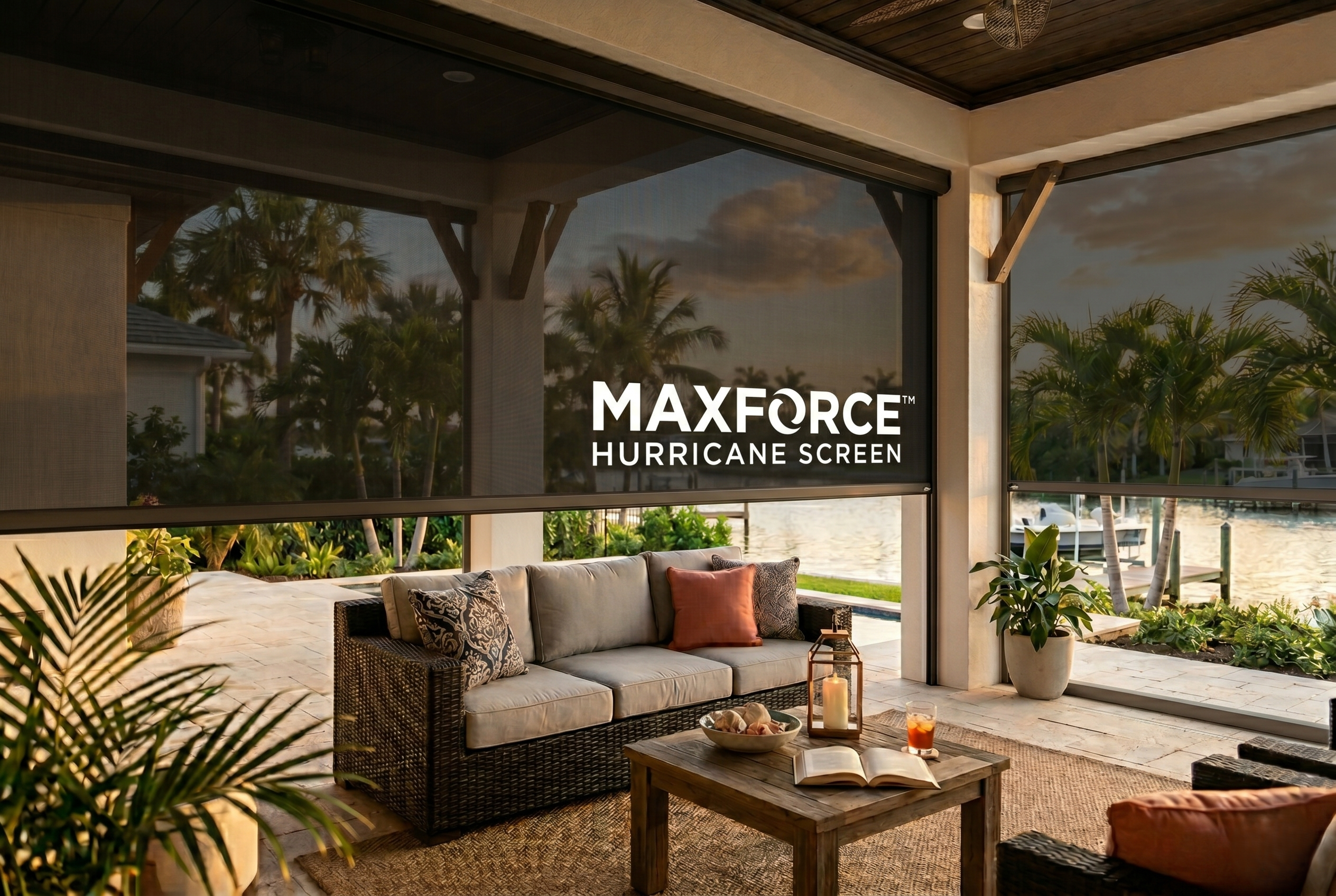
MaxForce™ hurricane screens are engineered for use in High Velocity Hurricane Zones and approved for Miami-Dade County under Florida Product Approval FL8637-R15, rated for the 185 MPH wind zone.
Products in this category matter because of the envelope rule. South Florida decided the opening was what mattered to protect, whether or not it had glass, and that made a covered outdoor room something that could be protected instead of written off.
What any specific opening requires depends on the structure, its exposure, and your local building department. That's a conversation for a licensed contractor, not a blog post.
Next in this series: what happened the last two times the Atlantic went a whole season without a hurricane.
Code history drawn from STRUCTURE magazine, the Florida Roofing and Sheet Metal Association, the National Association of Home Builders, and reporting by ABC News and Insurance Journal. MaxForce™ is a product of Fenetex® Corporation.
Next in the series: The Only Two Seasons the Atlantic Never Made a Hurricane