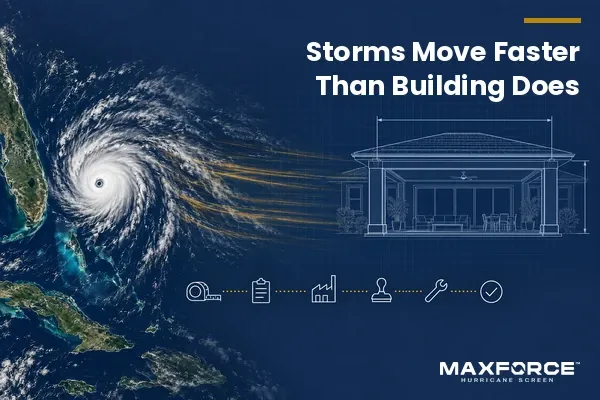
Storms Move Faster Than Building Does
The facts, up front
Andrew, depression to Florida landfall: eight days
The 1905 hurricane, Category 1 to Category 3: about one day
Atlantic season: June 1 to November 30, busiest around September 10
Steps between deciding and being protected: measurement, order, manufacture, permit, inspection, install
Lead-time figures in this article: none, on purpose — see below
El Niño and La Niña swap: every two to seven years
Service life of a fitted system: fifteen to twenty years
How much warning do you actually get?
Less than you'd think, and the number that matters isn't the one on the five-day forecast cone.
Take 1992. On August 16, the National Hurricane Center was talking to reporters about the hurricane season that hadn’t arrived. That same day, a wave off Africa organized into a tropical depression.
Eight days later it was over Homestead.
And Andrew was slow off the mark. It sat there for four days, getting knocked around by wind shear before it found clean air and took off.
The 1905 storm — the only hurricane of that entire season — went from Category 1 to Category 3 in roughly a day.
That's the actual window. Not the season. Not the forecast. Days.
How long does it take to protect an opening?
Longer than eight days. That much is certain without knowing a single thing about your house.
Here's what sits between deciding and being covered:
Somebody measures the opening. Openings are rarely square and rarely standard.
The system gets specified and ordered.
It gets built. These are made to the opening, not pulled off a shelf.
A permit gets pulled. Your building department sets that pace, not your contractor.
It gets installed.
It gets inspected.
Six steps. Two of them — manufacture and permitting — are outside anybody's control on the day.
None of that is fast, and none of it gets faster because a storm has a name.
Why we're not going to quote you a lead time
Because we'd be making it up, and you'd have no way to check.
Look up "hurricane shutter lead times," and you'll find numbers. Eight weeks here, two weeks of permit backlog there, quotes about off-season pricing. Nearly every one of those figures comes from a company that installs hurricane protection.
We’re in the hurricane protection business. So is everybody else quoting those numbers. None of it is independent, none of it is audited, and lead times in this business vary by product, county, season, and how busy a particular shop happens to be in a given month.
A number we invented and dressed up as research wouldn't help you decide anything. It would just look authoritative.
So here's the honest version. Ask your contractor directly, and get the answer in writing on the quote. Specifically:
How long from signed order to material arriving?
Who pulls the permit, and what is your building department currently running at?
Is the installation crew in-house or subcontracted?
What does that timeline look like in May compared with October?
Any contractor worth using can answer all four. If they can't, or won't, put it in writing, that's your answer about something else.
What happens to the calendar when a storm gets named?
Everybody calls at once. You don't need data for that one, just a sense of how people behave.
The Atlantic season runs June 1 to November 30 and peaks around September 10. The demand for storm protection follows the same shape, roughly, with a spike every time something is churning offshore with a name on it.
That spike is the worst possible moment to be starting a conversation. Every shop in the region is fielding the same calls, every building department is working through the same pile of applications, and the manufacturers are running the same backlog.
Everything takes longer at exactly the moment you need it to move faster.
Does a quiet season make it cheaper?
Maybe. We genuinely don't know, and we're not going to tell you it does.
The intuition is reasonable. Slow periods usually mean more scheduling flexibility and more attention per job. Whether it moves the actual price depends on material costs, on aluminum markets, on what your specific contractor is dealing with that quarter — none of which tracks the hurricane forecast in any way we could demonstrate.
You’ll see the cheaper-in-the-off-season argument made all over this industry, including on this blog. It might well be true. We can’t prove it, so we’re leaving it alone here.
The timing argument doesn't need it. The argument is that the work takes longer than the warning does. That holds whatever the price is doing.
So when is the right time?
When nothing is happening. Late in a season, after the last storm has cleared, is as close as it gets.
But there's a bigger version of this, and it's the point the whole series has been circling.
El Niño and La Niña trade places every two to seven years. Something fitted to an opening lasts fifteen to twenty years.
Install this autumn, and that system is on the house through several full Pacific flips. Through this El Niño, through whatever follows it, through the busy years and the dead ones and the ones nobody predicted.
Which means the state of the Pacific in the month you happen to install has almost nothing to do with what the thing is worth over its life.
This quiet season only changes how much time you have to think about it without a countdown running.
What to ask before you sign anything
Whoever you end up using, including us, these are worth asking.
Questions worth asking any storm protection contractor
A competent contractor should be able to answer most of these in about thirty seconds each.
Common questions
How much warning do you get before a hurricane hits?
Days, not weeks. The depression that became Hurricane Andrew formed on August 16, 1992, and made landfall in Florida on August 24 — eight days. Storms can also intensify very quickly: the only hurricane of the 1905 season went from Category 1 to Category 3 in roughly a day.
How long does it take to install hurricane protection?
It depends on the product, the opening, your county, and the time of year, and any specific figure should come from your contractor in writing. What is certain is that it involves measurement, manufacture, permitting, installation, and inspection — none of which happens in the days of warning a storm provides.
Is it cheaper to buy hurricane protection in the off-season?
Possibly, but we won't claim it. Pricing depends on material costs and individual contractor circumstances, not the hurricane forecast. The timing argument does not rest on price.
When is the best time to install hurricane protection?
Outside the season, when nothing is developing. Not because of price, but because ordering, permitting, and installing all take longer than the warning a storm gives, and everything slows down further once a storm is named.
Do I need a permit for hurricane screens or shutters?
Generally yes, though requirements vary by jurisdiction. Your contractor should pull it. If a contractor asks you to pull the permit yourself, ask why — it is a commonly cited warning sign.
Does a quiet hurricane season mean I can wait?
The season is the wrong unit. A fitted system lasts fifteen to twenty years while El Niño and La Niña trade places every two to seven years, so the Pacific's current state has little to do with the installation's value over its life.
Where MaxForce™ fits
MaxForce™ hurricane screens are engineered for use in High Velocity Hurricane Zones and approved for Miami-Dade County under Florida Product Approval FL8637-R15, rated for the 185 MPH wind zone.
What any particular opening needs depends on the structure, the exposure, and your building department. That's a conversation with a licensed contractor, and it's better to have it in October than the week a storm gets named.
That’s the end of this series. We started with an empty map at the peak of hurricane season and a record that had stood since 1914. Then, in October, the quiet season produced one major hurricane, and it came ashore in Florida. The useful conclusion turned out to be quite small: the number of storms in a season was never the number your decision rested on.
Storm timelines from NOAA's National Weather Service and the HURDAT2 database. This article does not quote lead-time, pricing, or scheduling figures for the reasons set out above. MaxForce™ is a product of Fenetex® Corporation.